INTRODUCTION


COLONEL STEWART FRANCIS NEWCOMBE was already a legend in the deserts of Arabia before he was joined in Cairo during the early months of the First World War by a a remarkable team of Middle Eastern specialists. One member of this group was T.E. Lawrence who went on to achieve worldwide fame. Colonel Newcombe's story, like those of other unsung figures in the Anglo-Arabian narrative, has been eclipsed by the legend of ´Lawrence of Arabia´, and has languished in the dusty recesses of regimental records, government files or in the elliptical words of Lawrence’s book Seven Pillars of Wisdom. However, S.F. Newcombe´s untold story is there to be told. BEYOND ARABIA is a story of extraordinary exploits and courage, coupled with Newcombe's own legendary and inexhaustible supply of energy and of remarkable adventures under the very noses of the Ottoman authorities – full of danger, intrigue and perhaps more surprisingly, of romance during Newcombe's captivity in Turkey. In the years between the two world wars, Palestine became Newcombe’s main preoccupation, especially after his retirement from military service, and he spent many years in helping to achieve a just solution in relation to the promises that were made to the Arabs during the war in return for their active participation in support of the Allied cause. For this untiring effort he will be best remembered. This is his story.

Tuesday, February 7, 2023

The Anglo-Turkish Earthquake Relief Fund 1939

Turkey’s President Recep Tayyip Erdogan said the earthquake that hit the area around Gaziantep in southern Turkey close to the border with Syria before dawn on Monday, 6 February 2023, was the country’s worst disaster since 1939. The war-ravaged northern border of Syria was also deeply affected by the 7.8 quake where most of the casualties were predominantly in the cities of Aleppo, Hama, Latakia and Tartus.

Erzincan destruction 1939

The disaster that Erdogan referred to was the 1939 Erzincan earthquake that also struck early in the morning of 26 December while most people slept. Seven violent shocks, the biggest measuring 7.8 on the Richter scale resulted in the loss of nearly 33,000 lives, injuring 100,000 and made several hundred thousand homeless. Ninety villages and 15 cities over an area of 30,000 square kilometres were completely destroyed in what is called the North Anatolian Fault Zone (NAFZ). The earthquake created a 360-km-long surface rupture, traces of which are still visible, and produced a strong tsunami wave of up to a metre high that swept across the eastern coast of the Turkish Black Sea in less than an hour. 

International response to the unfolding tragedy was prompt. On the British side, Sir Wyndham Deedes, an eminent British Army officer, civil administrator and a Turcophile, travelled to the region accompanied by archaeologist Professor John Garstang to distribute a wide ranging package of relief on behalf of the Anglo-Turkish Earthquake Relief Fund, an appeal initiated by George Lloyd, Lord Lloyd of Dolobran, then chairman of the British Council. His wartime colleague, Stewart Newcombe, was invited to join the executive committee and became its vice-chair. 

S.F. Newcombe

Newcombe knew many of the distinguished members that came forward to help coordinate the appeal for money, clothing, blankets, and medical supplies. Garstang was joined on the committee by fellow archaeologists Leonard Wooley and Max Mallowan and by Newcombe’s old colleagues from Egypt and the Hejaz such as Ronald Storrs, Colonel Buxton, and the Earl Winterton. One name stands out on the list - that of Lady Paul, known to many as the White Lady of Constantinople, an extremely courageous woman who had done much to ease the suffering of allied prisoners-of-war in Turkey, going so far as to facilitate escape and evasion at great personal danger. She had been instrumental in connecting Newcombe to leading Turkish officials seeking an armistice agreement when he was an escaped prisoner living undercover in Constantinople.

A mountain of aid in the form of clothing, blankets, medical supplies and even a fleet of ambulances were handled by a team of volunteers working day and night at a relief depot set up at St. Thomas’s Hospital in London. Clothing sufficient to aid 48,000 survivors were sent out to the affected area in the first month. The British press played up a story that a second-hand clothes depot had donated a quantity of policemen’s uniforms. “Police blue to clothe Turks” ran one of the headlines. Within 48 hours of the appeal reaching Lord Trent, chairman of Boots the Chemist, a donation of drugs was made to the value of £500. Over a two-day period, 27,000 letters were handled by the Post Office, most containing cash or cheques from as little as a halfpenny to £1000. Jewellery was donated to be converted into cash and one woman even sent in her engagement ring as she said her late husband had deep affection for the country. The £77,000 collected from British sympathisers was immediately spent on reconstruction materials such as galvanised iron sheets and roofing felt as well as extra clothing needs. 


First-hand report from Sir Wyndham Deedes

At this point the committee recommended stopping the general appeal due to the prevailing wartime conditions. They thought that the best help that could now be given was the erection of a modern hospital in Erzincan as a permanent token of friendship and so committee members were dispatched across the UK to seek financial contributions from leaders in commerce and industry. With the committee setting the total needed at £50,000, Newcombe travelled with Wyndham Deedes to various parts of the UK to promote the idea. 

Ultimately, it seems likely that the total destruction of Erzincan and its subsequent abandonment as a city led to the Fund reallocating its assets to other pressing needs. Erzincan was later founded as a new town on a fertile plain to the north.  

George Lloyd by William Roberts

Following the unexpected death of Lord Lloyd on 4 February 1942, the committee held its last meeting on 21 February.  The final accounts show how amazingly philanthropic the British public and industry leaders were during those early war years with a total donation of cash and in kind, as well as a significant concession from shipping and railways, amounting to a staggering £82,300 (equivalent to £4,961,152 in 2023 money). The balance of the Fund’s assets were later handed over to the Turkish Red Crescent Society with the proviso that £5,000 shall, in accordance with the wishes of the donors, be spent in Great Britain for the purchase of hospital equipment and medical supplies.

When the committee closed its books, the Second World War was already into its third year. The work of the Anglo-Turkish Earthquake Relief Fund, the prodigious efforts of a legion of volunteers, and the unbridled generosity of the general public at a time of great personal hardship, stands as a timely reminder of how powerful the cumulative effect of a thousand single acts of compassion to strangers in times of despair can be. 


Thursday, February 2, 2023

Hard work: Good prospects - the Devon and Cornwall Group Settlement Scheme to Australia

Hard work: Good prospects - that was the philosophy behind the Devon and Cornwall Group Settlement Scheme to Australia initiated in the early 1920s by Colonel Stewart F. Newcombe.

The Groups Settlement Scheme was a bold idea designed to encourage families from England’s West Country to settle in Western Australia. The original programme, set up in 1921 under the direction of the region’s Premier, Sir James Mitchell, had successfully cleared areas of dense forest in preparation for dairy farming to make the region self-sufficient in milk, butter, and cheese. To bring his dream to fruition, Mitchell needed more settlers and more money. For both, he turned to Britain where unemployment in post-WW1 England was high and especially so in the South-West following a gradual decline in local industries such as tin and copper mining. Stewart Newcombe’s close contact with Australian and New Zealand troops (ANZACS) at Gallipoli and on the Western Front warmed him to the opportunities that this vast continent and its people could offer. From his military posting at Raglan barracks, Devonport, he began to explore ways to promote its benefits to families from the local towns of Devon and Cornwall.

Clearing trees by chain and snig

Newcombe proposed a personal initiative that closely fitted with the scheme run by Sir James. To see its potential for himself, he was invited by Sir James to conduct a six-week fact-finding tour of the country that would hopefully result in a considerable flow of candidates to the region. Early in March 1923, and before a planned relocation to the War Office in London, Newcombe wasted no time in putting in for leave and informed Sir James that he and his wife, Elsie, were on their way.


The Newcombe’s arrived in Fremantle, Western Australia, on 5 April 1923 after a 45-day voyage and were met by their host Mr. Percy Stewart, the Federal Minister for Works and Railway. After disembarkation a short reception was hosted by the mayor and other dignitaries.  

Unfortunately, the Newcombe’s fact-finding mission did not get off to a good start. Soon after the reception they set off on the short nine-mile drive from Fremantle to Perth, WA’s capital city. The car in which Newcombe, Elsie and Mr. and Mrs. Stewart was travelling swerved to avoid a horse and cart on the road. Passing the cart, a piece of timber struck the upright which held the hood in position forcing the car to collide with an electric light pole with considerable force. Elsie was thrown forward into the windscreen which smashed over her cutting her face and lips. Suffering from shock she was treated by a local doctor before the group continued their journey to Perth where the Newcombes were lodged at the Palace Hotel at 108 St. George’s Terrace.  On Friday 6 April, the day after the crash, the incident was worthy of a mention in The Argus newspaper, which had been reporting Newcombe’s forthcoming visit since the beginning of the year.

After an initial meeting with Sir James there followed two weeks of meetings and receptions. Newcombe devoted his time to promoting the merits of his scheme, assessing the productivity of the country he passed through, appraising the rainfall and climate, and acquiring information as to markets and marketing facilities. Questions from the press focussed on the financial viability of his scheme with one reporter commenting that Colonel Newcombe’s scheme appears to be complex, and it will require most expert organisation if it is to achieve any measure of success. Newcombe responded by saying: “This is a draft of the scheme I drew up in England without consultation with your Premier. He may tear up our proposal, but I feel confident that he will submit something in its place which will be equally good or better for the people we wish to serve at home and in the interests of this State, and for the good of the Empire at large.”

On 18 April 1923, Newcombe and the investigating party visited two group settlements, Nos. 41 and 42, already successfully operating just nine miles west of the town of Denmark and close to the railhead. During the six weeks tour of the region, it was the first and only time he was able to get close to groups carrying the scheme forward where he witnessed the cooperative process of clearing, and chatted with the settlers and their wives, learning much of interest from the practical side of the joint enterprise. Strongly impressed by what he saw he unhesitatingly predicted success for the venture allowing for minor mistakes usual during the early stages. He and Elsie then embarked on a long train journey on the Trans-Australian Railway east to Melbourne via Adelaide to promote his scheme before the return journey home.

Impressed by the little that he had seen, Newcombe returned to the UK in June full of enthusiasm for the endeavour: "I consider the whole world can offer no finer opening for a working man than Australia provided he goes out under a sound scheme, and now we have got the scheme I think no man who is willing to work need hesitate a moment, for the prospects are exceedingly good." Early the following year he formed the Devon and Cornwall Migration Committee to deal with the promotion, administration, transportation, reception, and assimilation to the new country. Its members were duly instructed to tour the region with sophisticated publicity material to present to prospective pioneers.

Problems would later arise from what was seen as misleading imagery and statements depicted on lantern slides, films and posters and in pamphlets donated by the Tourist and Publicity Bureau of the Western Australia Government, a tone that was replicated in the committee's own locally produced materials that portrayed a seductive representation of what awaited potential applicants. The message was simple and unambiguous: "Those desiring to improve their positions and those of their children in various walks of life have here an excellent opportunity of working for their own benefit and being their own masters, provided that they are able and willing to work hard."  

Widespread publicity and well-attended meetings proved successful and initial uptake was encouraging; even Elsie was on hand, promoting the scheme from the women’s point-of-view. A programme of fund-raising was initiated to provide some families with money for incidental expenses such as the obligatory £3 per head landing fee, travel expenses to Plymouth, and in a few cases, even clothing and children’s shoes. 

Within less than a year the first group of specially selected emigrants assembled for embarkation on the S.S. Sophocles at Plymouth’s Great Western Millbay Docks. Twenty families, comprising twenty men, twenty women and sixty-one children were gathered together in preparation to sail into the unknown. Some said it was like the Pilgrim Fathers 304 years before them, only now their journey would take them south towards what had been described as “God’s own country”. 

Speeches were made, bands played and Lady Astor, the local M.P., distributed gifts - a scarf for each woman, a tie for each man, toys for the children and two silver cups to be competed for in games during the voyage. The Mayor, Solomon Stephens, not to be outdone, gave a framed photo of Plymouth to each family and a pen to each adult "with which to write home".


One speech, out of the many that were given that day, went a long way to help alleviate some of the anxiety felt by the pioneers. Mr. Hal Colebatch, Agent-General for Western Australia, was present to oversee the departure from Plymouth. His words accurately summed up the mood of the day: 

“I am not so old that I forget the day I left England 45 years ago, and I want you first and foremost to know that you are not in any way exiles from home,” he went on. “You are merely moving from one room to another, as it were, in the great house of the British Empire.”

As paper streamers broke the final physical ties to family and friends, the Sophocles set sail towards what all hoped would be a bright new future.  

“A land of golden opportunities, but not of feather beds”

On 7 March 1924 Albany welcomed the newcomers after their four-week voyage and provided temporary shelter and immediate needs for two or three days before the families were assigned to their groups. The Women’s Reception Committees took the lead in instructing the women in what to expect from farm life and how to cope in situations far removed from anything they would have experienced in the UK. Even Sir James Mitchell was on hand to welcome the families. Their arrival was recorded by the Western Australian newspaper: 

"Substantial ghosts of the Pilgrim Fathers walked the streets of Albany today. True, they wore no high-crowned wide-brimmed hats, no knee breeches, and no dour air. But they sailed from Plymouth Hoe a month ago, their Mayflower - the Sophocles, and their America - Western Australia. This morning the first 20 of what may be a procession of 1,000 Pilgrim Fathers - another 20 are already on the water and scores are ready to follow if the vanguard reports are favourable - descended the gangway of the Sophocles.”

The newspaper continued: "Some time ago, it will be remembered, Lieutenant-Colonel Newcombe visited Western Australia on behalf of the Devon and Cornwall Association, and inspected group settlement areas. The new arrivals say they have come because of the story he told, and they regard him with the highest respect.” The men were described as fine, physical types, many already acquainted with rural life. Among them were engineers, carpenters, blacksmiths, and other tradesmen considered useful in settlement life.

Sir James and the people of Albany extended them a hand of welcome at a meeting in the town hall before the families were due to depart by train to Denmark. “This is a great country of ours," Sir James told them in a rousing speech. “There are only 350,000 people here, so you are almost pioneers. You men and women from Devon and Cornwall have reached port today. You will arrive on your land tomorrow and, two days later will be at work on your holdings. No man can do anything for you unless you are willing to work. There is nothing in Australia we will not do for those who will work. There is nothing we can do for the man who will not work.”

Sir James then described the land that awaited the group: “Of course, it is a wilderness today, but you are good enough to conquer a wilderness. The average Englishman very readily takes to the bush in this country and very soon learns to love it.”

"More of you are coming naturally," continued Sir James, “and I hope that before long we will be able to adopt a British county name for all this country you enter.” Encouraged by his words the group cheered loudly. "Good luck to you all," said the Premier. "May you prosper and multiply: may you enjoy your lives in Western Australia, and may the work you do be amply rewarded."
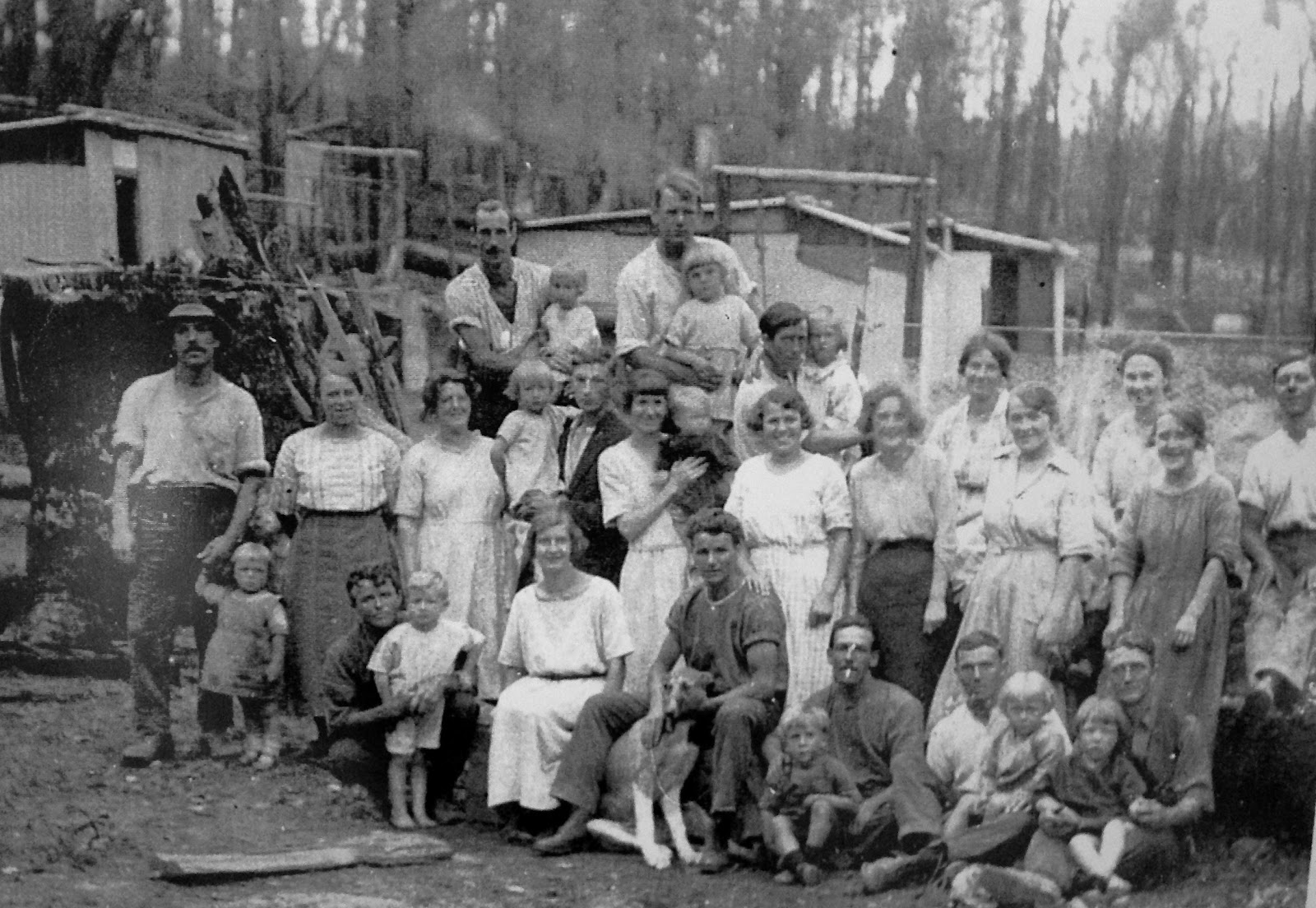

After being transported by train from Albany to Denmark the families were taken eleven miles west along the unmade Nornalup road by Reo trucks or horse-drawn carriages out into the forests where they had been assigned land on blocks that were described as containing “good swamp land, near to the sea, and embrace a commonage where fine pasture permits the immediate keeping of dairy cattle." Then, for the first time, the families understood the reality of their situation when they first caught sight of inadequate shelters of galvanised iron sheeting without windows or a floor. Eileen Croxford (née Cross), then a young girl, later recalled the moment they arrived at the camp of twenty shacks set up to receive the first of Newcombe’s groups known as Group 113: “Mum sat on her luggage, looked around and then said to Dad, ‘Do we have to live here? They wouldn’t put a cow in a byre like this at home’” For some, perhaps the dream died a little at that moment. The rest, buoyed up by the stirring words of the Premier, packed away their suits and ties, rolled up their shirt sleeves and got on with the job.

Initially, work consisted of back-breaking land clearance and by the mid-Thirties about 100,000 acres of dense forest had been cleared mostly by handsaw and fire. For those determined to make it work, and even before the stubborn-rooted Karri and Jarrah trees were felled, the hardy pioneer could already see in his mind’s eye a vision of lush pastures, fat grazing cattle and, above all, a prosperous future. 

But what started out as a 'sound scheme' soon ran into difficulties. A Royal Commission in 1926 found that land unsuitable for dairy farming had been included in the allocations and that a herd of fewer than 23 to 30 cows would not provide a farmer with a livelihood, but most settlers had fewer than ten. Unaware of the difficulties that awaited them, the 'Groupies', as they were known, made significant inroads into clearing the land, and then looked on helpless as their cattle inexplicably deteriorated into emaciated and infertile wrecks. As one settler, Fred Osborne, remembered: "After the enormous hardship of clearing the land, the care taken in establishing pastures and the excitement of stocking the new land, the animals just starved and died. In lush green pastures they simply lay down and died - bags of bones." It was not until the mid-Thirties that soil tests revealed a deficiency in the trace element cobalt. The cure was simple – with the addition of cobalt enriched Cow Lick into their feed healthy cattle once again grazed the Karri hills.  But a second blow to the farmers’ endeavours was about to fall.

When the Great Depression sweeping around the world reached Australia the country’s dependence on agricultural and industrial exports meant it became one of the hardest-hit countries in the Western world. Having conquered the land and solved the Denmark Cattle Wasting Disease the settlers were finally crushed by mounting debts as the price of butter fat plummeted and interest rates on their loans rose. After years of struggling most settlers were forced to walk off their land and abandon their efforts to a later generation. Fred Osborne’s family is one of the very few who managed to stay on, and the farm is still in their ownership today.

Group 113 member Eileen Croxford also stayed in the area. This is how she summed her time as a Groupie and what happened to her after:  

"We just lived in these shacks - no floor, no doors, no windows. I was out to work by the time I was 12. I was 20 when I got married and then I proceeded to have a family. Then the war came, my husband went away to Japan and didn't come back again". 

Newcombe's families

Newcombe and his fellow committee members have been accused of being seduced by the imagined landscapes projected by Western Australia’s publicity material while officials in Australia responded forcefully to the claim that blocks had been “window dressed” by insisting that all inspection trips were shown “as much as their time permits, and no attempt is made to conceal the sore spots”. Despite the criticisms, key values underpinning the enterprise were clear and unambiguous - hard work was at the heart of a scheme designed to appeal to anyone having difficulty in making a decent living at home, and were not afraid of getting stuck in. Newcombe never shied away from pressing this point home and never pretended that this was a land of feather beds.

Fifteen groups were eventually established in the Denmark area. They were identified by numbers. Newcombe’s groups were 113 (Parryville), 114 (Tealedale), 116 (Tingledale) and 139 (Hazeldale) – 136 families in all. They mostly arrived during 1924 and then a trickle until 1926 on the following ships of the Aberdeen Line: the Sophocles, Themistocles, Demosthenes, and the Diogenes. 
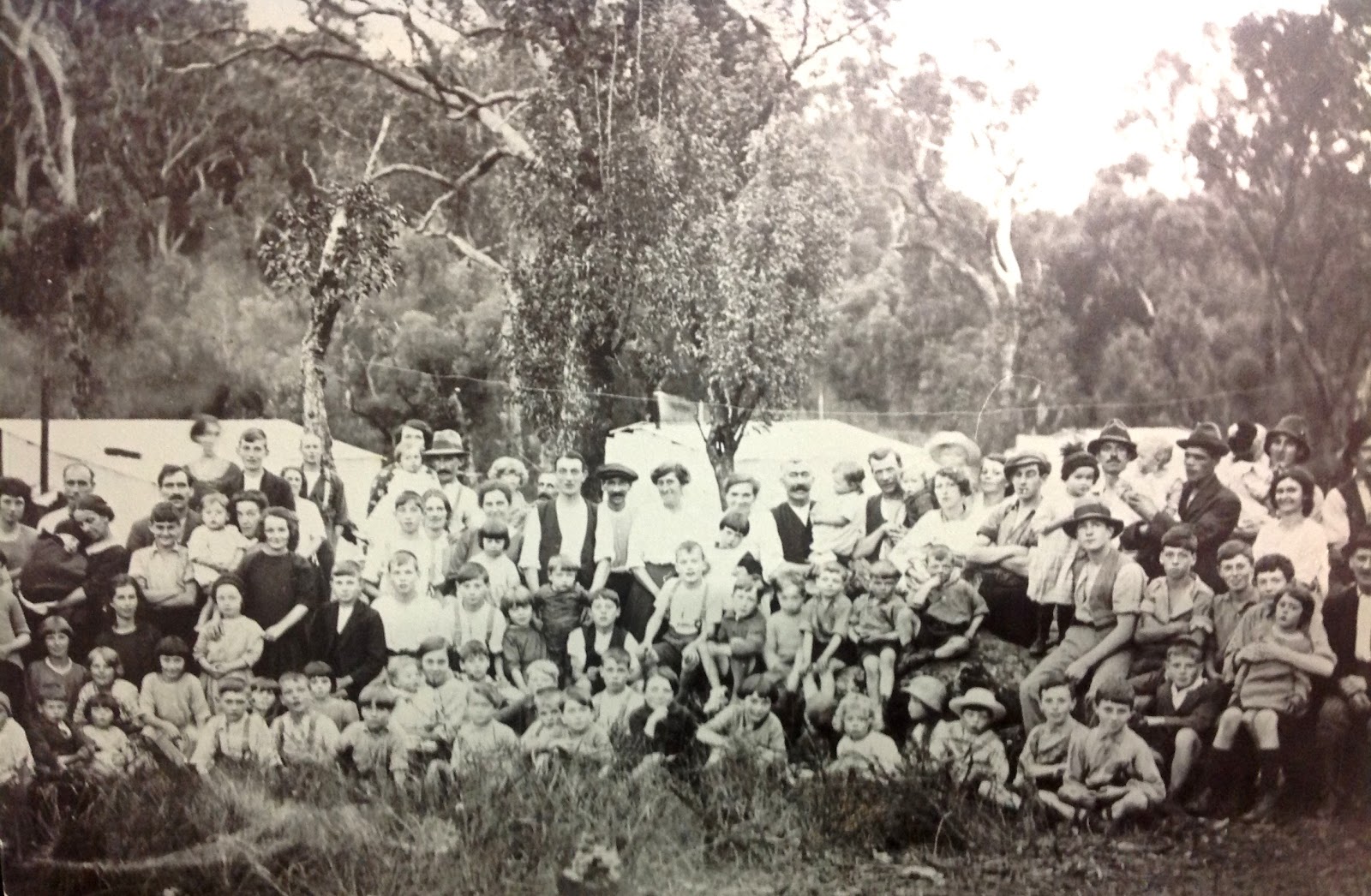
Group 116 Tingledale

The remarkable story of the Group Settlement Scheme forms a small part of the history of the development of Western Australia, but it is a story of how migration can help forge the identity of a new country. Today, the legacy of those pioneers reveals itself in unexpected ways. Although the project was declared a ‘glorious failure’ – for reasons far removed from the prodigious efforts of those involved – descendants of many of those early settlers are still in evidence across the region, and are thriving and prosperous. 

The legacy

The land that was assigned to the Groupies in Western Australia is breathtakingly beautiful, with a shoreline that contains some of the best beaches in Australia and where the might of the Southern Ocean crashes against dramatic cliffs and rock formations that seems to pre-date history itself. West of Denmark, 90-metre-high Karri and tingle trees – among the tallest in the world - are a tourist attraction in a national park that today embraces the term ‘Valley of the Giants’ as a marketing tool. In between this wonderland there exists successful farms that produce award-winning wines, succulent olives, and peppery virgin oil, complimented by honey and cheese – a not insignificant shift in economy from the 1920s and a world away from the privations experienced by the original settlers as they laid the foundation of today’s success. Self-catering accommodation located within many of the old block boundaries, now promoted as idyllic weekend retreats, completes the evolution from hardship and struggle to pleasure and relaxation.   

Backed by a strong economy and a robust tourist industry, today these are the things worth striving for on land that was once toiled with such stubborn determination and courage by a diverse group of individuals far from familiar comforts. Today, these farms form the backbone of modern Western Australia’s tourist industry, occupying the very same land that once broke the health, the spirits and the hearts of the men, women and their children who came to create new colonies on the far side of the world through sheer determination, endeavour and hope. This is their legacy.

Tuesday, March 17, 2020

The Boy in the Mask - a suitable Lock Down read!

Being locked down in a small Spanish town due to the Coronavirus pandemic with restricted movement outside of the home gives me the opportunity to read a book that I have only briefly delved into when looking for a specific item relevant to my own research. Now it's time to start at the beginning of the aptly named The Boy in the Mask. This is Dick Benson-Gyles' look into the 'hidden world of Lawrence of Arabia', from his Anglo-Irish heritage, his enduring fame as a leader of a Bedouin army, through to his quest for obscurity as a humble aircraftman; a book that author and television producer, the late Malcolm Brown, described as both moving and enlightened. In his Foreword, Brown wrote: "Dick Benson-Gyles has achieved something rather remarkable." 

So a good choice as today it is St. Patrick's Day. Time to explore Lawrence's Irish connections. Sláinte! 

Fresh light on a reluctant hero

Wednesday, January 8, 2020

'Beyond Arabia' - in the Journal of the T.E. Lawrence Society

The Journal of the T.E. Lawrence Society has recently published my article entitled 'S.F. Newcombe and T.E. Lawrence: Beyond Arabia', looking at the distinguished and eventful career of Stewart Newcombe. 

Journal Vol. 29, No. 1
Journal Editor, Ian Heritage, writes in the Notes on the Articles: 'Newcombe is already well known to us through his association with Lawrence. It was Newcombe who led the clandestine mission, on the eve of the First World War, to survey and map the 'Wilderness of Zin', a hitherto uncharted area of southern Palestine and then part of the Ottoman Empire.

Lawrence and Leonard Woolley provided cover for the mission by undertaking an archaeological survey of the region. Lawrence later worked alongside Newcombe during the subsequent conflict, firstly in Cairo in military intelligence and then blowing up sections of the Hejaz Railway. However, as with many other personalities associated with Lawrence, the rest of Newcombe's career has been eclipsed by this famous association.'

The Journal was set up in 1991 as a serious research publication and forms one of the prime resources for anyone seriously interested in Lawrence.

All contributions are reviewed by an editorial committee. Editorial policy is to publish articles relating to all aspects of Lawrence’s life, including some based on papers presented at the Society’s meetings, as well as material from obscure published or unpublished sources.

A limited number of back-issues are available for purchase by non-members from the Society's website

ABOUT THE SOCIETY
The T. E. Lawrence Society (Registered Charity No. 297940) was born at the Red Lion Hotel, in Wareham, Dorset, on 29 June 1985, in the presence of around 30 founder members. Its foundation coincided with the 50th anniversary of the death of T.E. Lawrence.

The Society is a non-profit organisation registered under British law as an educational charity. By the terms of its Constitution, the Society exists:

‘to advance the education of the public in the life and works of T. E. Lawrence and to promote research (and to publish the useful results thereof) into his life and works’.

The most important gathering organised by the Society in the UK is the Symposium, held every two years. The Society also maintains a research collection which is kept at Wareham Library in Dorset. It can be consulted by arrangement with the library by any member of the public.
For enquiries or to join the Society, you can contact them here

Sunday, December 8, 2019

Endangered archaeology


After all the years I've spent researching the life of Stewart Newcombe he remains a fascinating and absorbing character, still able to surprise and still surprisingly relevant. Recently, one of his many diverse interests overlapped with a contemporary research project run by three leading British universities which has at its core the protection of endangered archaeological sites across a study area of 7000 kilometers and in more than twenty countries throughout the Middle East and North Africa. 

The EAMENA Project, a five-year Arcadia Foundation funded project (2015-2020), was set up to record and make available information about archaeological sites and landscapes which are under threat across the Middle East and North Africa. The project is based in the Universities of Oxford, Leicester and Durham. The archaeological heritage of the region, which is of international significance for all periods, is under increasing threat from massive and sustained population explosion, agricultural development, urban expansion, warfare, and looting.

The project uses aerial photography and satellite imagery to map unrecorded and endangered archaeological sites, to a uniform standard, and evaluates and monitors their condition. The information provided will assist with the effective protection of these sites by the relevant authorities. The use of satellite and aerial imagery is especially important for those countries where access on the ground is currently either impossible or severely restricted (e.g. Syria, Libya, Iraq and Yemen). 

Michael Fradley, an archaeologist at Oxford University who manages the project, contacted me seeking information on Newcombe who was an important early advocate for the use of aerial photography for photogrammetric mapping. After the end of the war Newcombe remained very vocal about the potential of the technique. In 1920 he pushed for an experimental air survey by the Royal Air Force of the Nile flood region from the old Aswan Dam to the Cairo Barrage for water management purposes but for other projects he came up against significant opposition, not least an unwillingness among the Corps of Royal Engineers to move beyond their traditional ground survey methods.

Newcombe at his Oxford house. Courtesy of Joseph Berton


Fradley, during a visit to the National Museum of Iraq in Baghdad, wrote to ask: "Just out of interest, do you know which house Newcombe lived in on the Woodstock Road in Oxford. I find myself trying to guess every time I get the bus in to work." 

Today: The site of Newcombe's former home
It is easy to see why Fradley missed it. The house at number 300 has been long gone, demolished to make way for a rather unremarkable estate of flats, which by a strange twist of irony is just a few streets away from the EAMENA Project's office. Woodstock Road is a major road running through the leafy suburb of North Oxford but the clue is obvious as Newcombe was credited when they built the current development and a prominent sign was placed at the entrance. It is doubtful if the residents of Newcombe Court are aware of the connection. 


Newcombe's air survey of the Nile in September 1920 produced 1200 glass plates of overlapping photographs but only a section of one plate was used in his 1921 paper  'Contouring by the Stereoscope on air photos' (RE Journal Vol. XXXIV July-Dec 1921). It is not known if this photographic archive exists. "If the full series of 1200 photographs survives and could be located," Fradley reflects, "it could be of major value to archaeologists to identify and document sites destroyed or eroded by the modern occupation of the Nile valley, which has increased significantly in intensity over the past 100 years." 

Contoured hills east of Cairo

Newcombe's paper won him the Royal Engineers’ prestigious Montgomerie Prize in recognition of his contribution to exploration and surveying and he continues to achieve recognition in academic journals over one hundred years later. There is a natural evolution from when a plate camera was first strapped to the wings of a wood and canvas aeroplane to the use of equipment like drones or satellites. Newcombe’s reputation was built on surveying by horse, camel or by foot across inhospitable lands often in the most appalling of conditions. At heart he was an adventurer and loved nothing better than to ride off to see what was over the next hill. But without doubt the technique of mapping the world by aeroplane and camera had begun to expose much more of its unknown and unknowable parts, more than could ever be achieved by land surveying. 

For many years Newcombe enjoyed the connectivity to the environment, and more importantly to its inhabitants, yet at the same time he recognised the need to explore ways to break free from the rigours and difficulties of those journeys and to see the world from new and exciting perspectives through the utilisation of emerging technologies that he helped develop and promote. As such he was clearly a man of his time who lived to enjoy the best of both worlds.  

For more information about the work of EAMENA, go to eamena.arch.ox.ac.uk

Monday, May 13, 2019

A ten shot discovery


Maynard Owen Williams paid a second and equally memorable visit to the ancient Hittite site at Carchemish (see my previous article dated 02 May 2019) on the day when the excavators struck a rich find.

As the excavations progressed and 3000-year-old Hittite remains began to reveal themselves the great game of rewarding the fellows by allowing them to announce new discoveries by firing off their pistol was abandoned and a more ritualised format was devised. The site headman, Hamoudi, his title in this role being the chawish, was given the prerogative to fire his revolver as a signal to the archaeologists and the far-flung teams to down picks and join in with the celebrations, but first he had to judge the quality of the find - one shot for a fair-sized fragment of basalt rising to seven or eight for a complete slab with figures and inscriptions, and so on. In time, the men were vying with each other for the most cartridges expended for their discoveries and would complain to Hamoudi: “Oh, but six shots, ya chawish, six shots: was it not five for the chariot yonder? And here there are three sons of Adam; by God, they deserve two rounds apiece.” This practice acted as baksheesh to the finder, valued just as much as any monetary reward that was added to their wages, and encouraged the men to aspire to the honour of being able to say, “That is the stone of Yasin Hussein for which he had eight shots.” In this way, the find not only benefited the finder, but also his immediate team which typically comprised four men – a pick-man, a shoveller and two basket-men. They were each paid a proportionate bonus. To many believers it also paid homage to the stone and to the good fortune that put it in their path.

One day in October 1913 the excavators struck a rich find. Working beyond the King’s Gate the men found a return buttress that was only 6 inches away from the limit of their excavations the previous season. This new direction led them to discover enormous decorative slabs of basalt and white limestone depicting drums and trumpets heralding a seated goddess followed by 15 servants carrying percussion instruments and mirrors. Then more slabs showing men carrying gazelles on their shoulders until a break which revealed a door flanked by huge panels of Hittite inscriptions. Lawrence called it a great find, “the greatest we have ever made.”

If patience was the archaeologist’s most important virtue then theirs had paid off. Campbell Thompson recalled how week after week of digging would reveal nothing; “a weary and indefinite time of waiting” he called it. And then... “on a sudden the most glorious treasures will be revealed, tasking your time from dawn to sunset.” Having been drawn into the seductive world of the archaeologist, Maynard Williams had returned in time to bear witness to this momentous occasion. “I was at Carchemish on the day the greatest Hittite find ever unearthed was revealed to the eye of man for the first time in three thousand years. I have never had a more exciting time in my life.”

It was hoped that their patience and efforts might reveal something of real significance – perhaps a find as rewarding as a Hittite version of the Rosetta Stone from which they could decipher the lost language of the Hittites. Williams describes the moment the find was revealed to the team: 

"When the enthusiastic labourers had carefully uncovered the precious dolerite slab, and the overseer, bending over it like some near-sighted Silas Marner caressing his gold, had discovered that it bore the longest Hittite inscription ever found, ten shots from a big Colt revolver, fired as a baksheesh to the stone, echoed and re-echoed across the Euphrates, and workmen and directors knew that a big find had been made. Pandemonium was let loose. Labourers came running from all directions to share the joy of discovery. I also shared in that joy. I shouted congratulations to Khalil, the giant pickman. “Praise be to God!” I cried. He grinned so I could see all his teeth, and answered, “God’s blessing return to you!”   

The find was important but it was not the key to the language they were hoping for. The answer to this particular mystery would come just two years later in 1915 when a Czech Orientalist and cryptographer named Bedřich (Frederich) Hrozný was conscripted into the Austrian Army as a clerk and in the midst of war found he had plenty of time to study a set of tablets he had the foresight to copy in Istanbul before war commenced. Recognising the single Babylonian sign for bread set him on the path of unlocking the ancient riddle. With knowledge, perseverance and a few lucky assumptions he was able to decipher just one sentence, but it was enough. It read: “Now you will eat bread and drink water.”

It was not until 1919 that Woolley was able to return to their old site on the banks of the Euphrates which was now in an area of post-Ottoman Syria controlled by French forces. Despite enquiries to Frederic Kenyon, the Director of the British Museum, Lawrence found it impossible to return to his old life. In fact, his immense fame would prohibit him from ever being able to continue with his archaeological career in a post-Versailles world riddled with a suspicion of king-makers. “Woe’s me,” he once wrote, “I suppose I’ll never dig anything again.”

Thursday, May 2, 2019

Carchemish - A Kurdish Glee Club with college trimmings


Thomas Edward Lawrence (Lawrence of Arabia) attended the City of Oxford High School for Boys during the years 1896-1907 before studying history at Jesus College, Oxford, where in 1910 he gained a First Class Honours degree largely based on an outstanding thesis on Crusader castles which had involved a lengthy walking tour in Palestine and Syria. He then joined the British Museum’s excavations of the ancient Hittite capital at Carchemish on the River Euphrates under the direction of D.G. Hogarth who would become his mentor and of whom he once said, ‘I owe every good job ... I've ever had in my life.’

The digging season of 1911 was the first to be carried out at the site for thirty-years. Having set up the digs in March, Hogarth handed over to Reginald Campbell Thompson, previously an assistant in the Egyptian and Assyrian Department of the British Museum, who ran the site with Lawrence as his assistant until July of 1911. The field campaigns of years two, three and four were under the directorship of C. Leonard Woolley, an experienced archaeologist who became best known after the war for his work at the ancient Sumerian city of Ur in present day Iraq. Looking back from beyond the war years, Lawrence remembered the time spent digging at Carchemish as a golden age, with a young Syrian Arab assistant named Dahoum as his almost constant companion. “We were there for four years,” he recalled, “and it was the best life I ever lived.” 

Lawrence and Woolley with Dahoum seated to the far right next to Hamoudi

Throughout the four years that the site was excavated before war interrupted diggings Carchemish attracted attention from scholars and serious travellers from Europe and America. Among them were engineers, archaeologists, soldiers and diplomats, all requiring hospitality and usually a tour of the site, prompting Lawrence to describe them as worse than fleas. One such flea was a young missionary teacher from the Syrian Protestant College (later the American University of Beirut), Maynard Owen Williams, who arrived in 1913 and wrote an account of the British Museum’s excavations where Lawrence makes one of his earliest appearances in print in the popular and widely-read newspaper, the New York Sun (21 September 1913). Williams, a 25-year-old graduate of Kalamazoo College, Michigan, was a keen observer and recorder in both the written word and as an early pioneer of travel photography. For the next fifty years he would make a significant contribution to the National Geographic Magazine as its first foreign correspondent. 

His coverage provides a picturesque and unique insight into the lifestyle of the archaeologists at Carchemish. “‘Both Woolley and Lawrence are disappointing archaeologists,” he wrote. “I expected to find grey-haired old men with spectacles and a scholarly stoop.” Williams, writing in the year prior to the Zin survey, described Lawrence as: “...apparently in his early twenties, a clean-cut blond with peaches and cream complexion which the dry heat of the Euphrates Valley seemed powerless to spoil. He wore a wide-brimmed Panama, a soft white shirt open at the throat, and Oxford blazer bearing the Magdalene College emblem on the pocket, short white flannel ‘knickers’, partly obscured by Scotch decoration hanging from the belt, which did not, however, obscure his bare knees, below which he wore heavy grey hose and red Arab slippers.” 

Williams continued with his theme of mock denigration: “Woolley is hopeless as an archaeologist.  He is young and friendly and as companionable as a college chum.  Surely not the stuff of which archaeologists are made.” The author, though, was only teasing his readers and had not been fooled by the perceived ‘romance’ of the trade. “But I fancy,” he wrote, having already guessed the truth, “that these two young men are competent to hold down the Carchemish 'digs' for a while at least; for better than their years of excavating and their skill in using French, German, ancient and modern Greek, Turkish and Arabic, is their remarkable knowledge of men. I cannot give a correct estimate of their worth as archaeologists, but I do say that they know more about handling Orientals than any man I have met during my two years in Syria.” It was a pertinent observation and the key to why Lawrence would later be so successful in waging unconventional warfare in the deserts of southern Arabia with an irregular native force. 
 
Carchemish (Karkemis) with part of the workforce
Williams then went on to describe a memorable evening spent with the archaeologists as their guest at what he called ‘A Kurdish Glee Club with college trimmings’. He had walked for miles through a pitch black night as a thunderstorm raged, one of those severe weather fronts that from time to time swept across the valley of the Euphrates lighting up the landscape with electrically charged flashes and filling the warm night air with booming cracks of thunder. One such illumination showed Williams that he was standing on the very precipice of a test shaft some 20 feet deep that the archaeologists had sunk a short distance from the house. He was hugely relieved when Hamoudi, the site foreman, answered his hammered arrival and ushered him into the excavators’ cosy residence. He was heartily welcomed by the occupants of the house who in a show of international solidarity graciously accepted this young American in his college football sweater, emblazoned with a big orange K. Sartorially, he had stiff competition that night as Lawrence was sporting a white Magdalen blazer trimmed with red and Woolley one of bright green, trimmed with white. “It was,” Williams wrote, “if one overlooked the Kurdish musicians huddled at the far end of the room, a most ‘collegey’ looking group. The air was thick with smoke from Hogarth's pipe and Woolley’s cigar, and the wind outside could whistle chilling tunes without detracting from the cosiness of the low room and its dark, rich hangings.” 
Carchemish Expedition house interior

Williams had seen much on his travels to inspire him to write or photograph but the scene he was about to witness was unlike no other. Even before the music started the hushed room was charged with an electric atmosphere that complemented the atrocious conditions outside the shuttered windows where a wind was howling around the house like a fury. A grizzled Kurd sat quietly awaiting his turn to sing with his shepherd's pipe across his lap. In his deep-set eyes there was a far-away look. The Kurd seated beside him was a true man of the desert who Williams describes as “swarthy of skin and clear of eyes, his thin lips compressed to a narrow line, his sun scarf draped gracefully around his head and neck.” The musical instruments that the men carried were of particular interest to Williams. He had even seen one of them illustrated on a three-thousand year-old Hittite carving. When the first man began to pluck at his instrument it was with the skill of a hundred generations animating his fingers. “Certainly it was no modern music that came from the mandolin-like affair with the long neck and the small body,” recalled Williams. “It was a spirit of the ancient days returned to play for the men who had rediscovered the site of the brilliant Hittite capital.” 

What happened next is best described by Williams himself: 

“Hogarth rapped the ashes from his pipe and threw his leg over the arm of the easy chair. Lawrence, the blond Oxonian, curled down into the throne-like seat, in which his white suit stood out from the soft-toned background of a Persian rug. Woolley motioned the musicians to begin. The accompaniment seemed to be the echo of the winds that swept across the Euphrates and moaned as they passed on across the city of ruins. But it was something different when the old singer blew a few notes on his pipe. The windy wastes were now inhabited. The spirit of man animated the scene with the sad, shrill cry of a creature in pain... The figures of the room were blotted out. This was no concert music, designed for bright lights and well-dressed audiences. A soul was stirring in that flute, an out-of-door spirit communing with its God across vast distances, but with a sense of sympathetic nearness. He began to sing. I started at the first note. It was a protest against the wrongs of the Angel of Death, a plea for mercy at the hands of a determined despot. Each note was wrung from the heart of a despondent soul, fearing, pleading, crying out for a relief that would never come... The eyes of the singer were fixed; the cords of his throat were visible under his swarthy skin. The veins of his forehead stood out under his dark kaffiyeh, and with each line he seemed to swallow, to choke back a sob that was springing to his lips.  For some time I could not turn my head. I had forgotten the others. I could not understand the words of the singer, but the music wrenched my heart.  I turned to Woolley and asked what the man was singing. It was the lament of a Kurdish woman whose husband, Said Ahmed, the greatest of warriors, had been brought home dead. I understood the sorrow of the song, its harrowing complaint against an unkind Fate. 

Then, in an instant, the music changed. The notes were the same; the rhythm was unaltered. The singer was as still as if he were carved out of rock, but the soul-stirring complaint of the bereaved wife at the death of her loved one was changing to the cunning, low, tense song of a Jael at the side of Sisera. Revenge was taking place of despair. Hatred was blotting out womanly love. The funeral chant was fast becoming a battle-song, in which the hatred of a race was stirring murder in the hearts of her hearers. This woman, after kneeling by the side of her husband's dead body, had raised herself to a proud height, and with outflung arms like Davidson's “France” was praying that his tribe would avenge her husband's death. A Fury, with ghastly face and disordered hair, was hurling Death back upon itself, was already sucking sweetness from the thought of pillage and bloodshed. A note of victory crept into the awful chant. Then Deborah's song of conquest and thankfulness burst forth - cruel, menacing, exultant. In a moment it was over. Only the shrill sound of the pipes remained. The woman, having seen her tribe depart on its mission of revenge, was once more at the side of her loved one, whose cold lips would not respond to her long, passionate kiss." 

Other than Lawrence's own letters home to his family, I think there is no better contemporary description of a day in the lives of the Carchemish team in their expedition house. It was certainly an evening that Williams would not forget. Some twenty years later and after Lawrence had achieved worldwide fame he made a point of writing to remind Lawrence of the occasion and the fond memories it still held for him. It was 1932 and Williams had long been a key National Geographic contributor. In his letter to Lawrence he asked if he would like to write an article, "one that would lend itself to photographic illustration and related to geography or some other non-political phase of your life and travels". Unfortunately, nothing came of his enquiry and Lawrence continued with his boat development work for the Royal Air Force until his retirement on 25 February 1935 and subsequent death in a motorcycle accident less than three months later.  

"Be sure my kindest regards, linked with happy memories, are yours," Williams wrote. Those last poignant words written to the 'clean-cut blond' of Carchemish recall a simpler time when desert winds swept across the city of ruins like a Kurdish lament carrying the dreams of two young men beyond Arabia to a world as yet undiscovered. 

The life and work of Maynard Owen Williams needs further exposure than this brief article can provide. Be sure to check out his work which can be found on the web and in the archives of the National Geographic Society and the Kalamazoo College. As a pioneer of travel photography he was more than just a self-described "camera-coolie and a roughneck". Having travelled by his own estimate 25,000 miles per year for more than a quarter of a century his efforts produced more than 2,250 self-illustrated pages in the Society's prestigious magazine. His secret to staying out of danger in some of the most dangerous of situations was in meticulous advance planning. As he put it: "Helter-skelter adventure and work of solid scientific worth do not go together as a rule."