Having left education early to pursue a career within the creative sector, I found myself aged 17-years-old academically short-changed and in need of further self-development. I filled these gaps through the reading of books, any books, but especially books on art and design that might disguise the obvious absence of any formal training. I decided to join a popular postal book club which had an attractive introductory offer but also the annoying habit – certainly to this otherwise preoccupied teenager - of sending the Editor's Choice if you didn't physically write in to say you didn't want it, and so on more than one occasion I was forced to accept an unwanted book that I certainly couldn’t waste limited funds on. That was how I came into possession of a book with an intriguing title, Seven Pillars of Wisdom. The title was one reason I decided to keep the book, the other – and this appealed to my eye for design – was its evocative cover showing a string of camels in silhouette set in contrast against a burnt orange sky. The writer’s name was unfamiliar to me, although in hindsight I must have seen David Lean’s epic film, Lawrence of Arabia, and having made no connection between book and film it was my hunger for knowledge that made the book and not the film the catalyst for my continued education.
It was Jeremy Wilson, Lawrence’s authorised biographer, who once wrote: “In general, people who are interested in cinema, and people who are interested in history, are on roads that never meet.” When Lawrence’s brother, Arnold, saw the film he said: “I should not have recognised my own brother.” But it is the film that has presented Lawrence to the widest possible audience. As Wilson observed: “For every person who has spent three hours reading a serious book about Lawrence's life there are probably hundreds, if not thousands, who have seen the film.” If the film had been less successful then perhaps we would not be here today.
Being a heavy and unwieldy tome, Seven Pillars was difficult to hold in one hand as I made the daily commute into London in a standing-room-only train carriage. But despite the discomfort I held the vain hope that the title alone might make me look a little more intelligent to my fellow passengers. Was there ever a shallower reason to embark upon a lifelong quest for knowledge?
I hadn't travelled far on my very first journey in company with Lawrence - a typically dull, dreary and grey London day - when I came across the following passage:
We were fond together, because of the sweep of the open places, the taste of wide winds, the sunlight, and the hopes in which we worked. The morning freshness of the world-to-be intoxicated us. We were wrought ought up with ideas inexpressible and vaporous, but to be fought for. We lived many lives in those whirling campaigns, never sparing ourselves: yet when we achieved and the new world dawned, the old men came out again and took our victory to re-make in the likeness of the former world they knew. Youth could win, but had not learned to keep: and was pitiably weak against age. We stammered that we had worked for a new heaven and new earth, and they thanked us kindly and made their peace.
All men dream: but not equally. Those who dream by night in the dusty recesses of their minds wake in the day to find that it was vanity: but the dreamers of the day are dangerous men, for they may act their dream with open eyes, to make it possible.
As the overcrowded carriage pulled into Waterloo Station, Lawrence's description of "the sweep of the open places, the taste of wide winds" struck me as a stark and obvious contrast to my current situation. I was captivated, and have been ever since.
Still eyes look coldly upon me,
Cold voices whisper and say --
'He is crazed with the spell of far Arabia,
They have stolen his wits away.'
Victoria Ocampo, who wrote what Arnold once said was "the most profound and the best-balanced of all portraits of my brother," felt affinity with Lawrence through a shared love of the vastness of open places: in her case, the pampas of Argentina.
It is the desert that is the essence of the saga, in both film and fact. Lawrence immersed himself in its alien ways, while Stewart Newcombe, Lawrence’s senior officer, fought hard to step outside the limitations set by his military background and training and adapt to its inhumanities and frustrations. Despite being an experienced desert explorer, Newcombe was eventually overwhelmed by the environment and the materiel he was given to work with. Lawrence, the archaeologist turned nonconformist subaltern, had no such limitations.
Eager to explore the open places of Lawrence’s description myself, I travelled whenever I could throughout the Arab countries of the Mediterranean and beyond. As a photographer and designer I was able to find work in Cyprus, Egypt and eventually Dubai, the latter at a time when the desert still needed taming each day lest it overwhelm the as yet undeveloped city.
 |
| Dubai Creek, 2017. Still retaining its original charm. |
My desire to visit Dubai sprang from a separate book, Arabian Sands, by British explorer and travel writer Wilfred Thesiger. This is how Thesiger portrayed Dubai in 1952, before massive oil profits accelerated the city's expansion:
I then went to Dibai and stayed with Edward Henderson. We had been together in Syria during the war. He was now working for the Iraq Petroleum Company, making preparations for the development which was expected there, but of which there was mercifully as yet no sign. He lived in a large Arab house overlooking the creek which divided the town, the largest on the Trucial Coast with about twenty-five thousand inhabitants. Many native craft were anchored in the creek or were careened on the mud along the waterfront. There were booms from Kuwait, sambuks from Sur, jaulbauts, and even a large stately baghila with a high carved stern on which I could make out the Christian monogram IHS on one of the embossed panels. This work must have been copied originally from some Portuguese galleon. To the English all these vessels were dhows, a name no longer remembered by the Arabs.
Naked children romped in the shallows, and rowing-boats patrolled the creek to pick up passengers from the mouths of alleys between high coral houses, surmounted with square wind-turrets and pleasingly decorated with plaster moulding.
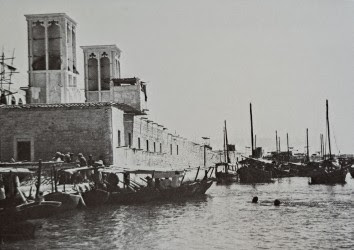 |
| Thesiger's photo of Dubai's wind towers, 1952 |
Behind the diversity of houses which lined the waterfront were the suqs, covered passageways, where merchants sat in the gloom, cross-legged in narrow coves among their piled merchandise. The suqs were crowded with many races – pallid Arab townsmen; armed Bedu, quick-eyed and imperious; Negro slaves; Baluchis, Persians, and Indians. Among them I noticed a group of Kashgai tribesmen in their distinctive felt caps, and some Somalis off a sambuk from Aden. Here life moved in time with the past. These people still valued leisure and courtesy and conversation. They did not live their lives at second hand, dependent on cinemas and wireless. I would willingly have consorted with them, but I now wore European clothes. As I wandered through the town I knew that they regarded me as an intruder; I myself felt that I was little better than a tourist.
But it was not just what Thesiger wrote about the town he called Dibai that attracted me. He illustrated his book with beguiling black and white photographs, and one image in particular caught my attention. It showed the “high coral houses, surmounted with square wind-turrets” that was located by a wide creek that flowed through the town. These were just two of the many barjeel wind towers of Al Bastakiya, a neighbourhood built in the 1890s by Persian merchants looking for trade opportunities and named after Bastak, a town in southern Iran. The towers were designed to expel hot air and to funnel cooler air to the living quarters below, providing passive cooling solutions that predate modern air-conditioning.
 |
| My photo of a souk trader, 1981 |
I reached Dubai just in time to photograph them myself before half of them were demolished in the 1980’s. The remaining towers were only saved through the intervention of British architect Rayner Otter. His efforts culminated in a letter to Prince (now King) Charles, who visited Dubai in 1989. The Prince advocated for their preservation, halting plans for their demolition and igniting a revival that saw the towers restored in 2005. The area, also known as the Al Fahidi Historical Neighbourhood, is now a major tourist zone with tea houses, a coffee museum, art galleries, boutique shops and the Sheikh Mohammad Centre for Cultural Understanding.
It doesn’t seem to matter when you arrive anywhere in the world, you will hear a phrase that goes something like this: “You should have been here ten years ago”. There were still a number of European expatriates living in Dubai who had arrived before 1971 when it was then part of the British Protectorate called the Trucial States, and for whom this was a common refrain. By the end of that decade, and largely by their efforts, the town began to change from an old pearling and re-exporting hub into a modern and vibrant city-state, attracting all kinds of people from around the world - oil men and their families, the military, financial advisors, architects and civil engineers, construction workers, hospitality, and a rapidly developing media industry.
 |
| Shy sailors, Dubai 1982 |
Ten years to the month after Prime Minister Edward Heath ended the treaty relationships with the seven trucial sheikhdoms, I arrived to take up a position as the art director of a small advertising and publishing company founded by Ian Fairservice just two years previously with his business partner Obaid Humaid al Tayer, later the Minister of State for financial Affairs. Ian originally came to Dubai as assistant manager of a hotel and was also influenced by Lawrence’s Seven Pillars of Wisdom which he had read as a schoolboy. He eventually met and published books by Wilfred Thesiger, whom Ian had long admired. When Thesiger came to the UAE for an exhibition of his photography sponsored by the British Council, Ian asked him what, if anything, remained unfulfilled for him. Thesiger said that he's always dreamt that one day the very Arabs who he had written about in Arabian Sands would be able to read the book in their own language. Within a year, Ian had secured the worldwide rights to publish the book in Arabic, and so began a 13-year relationship during which he published twelve of Thesiger's books.
 |
| Dhow captain, 1982 |
My time in Dubai was marked not just by the beginning of a rapid acceleration of growth from oil revenues, but by the vision of its ruler, Sheikh Rashid bin Saeed Al Maktoum, who planned for the eventual decline in the dependency on oil with an ambitious construction programme which allowed the emirate to not only survive but thrive in an economic market where oil production contributed less than 1 percent of the emirate's GDP by 2018.
There is a question mark over whether Sheikh Rashid said the following: "My grandfather rode a camel, my father rode a camel, I drive a Mercedes, my son drives a Land Rover, his son will drive a Land Rover, but his son will ride a camel".
If he didn’t, a similar train of thought might well have motivated his desire to set in motion an ambitious vision for the future of his young country, a vision now carried forward by his son and current ruler of Dubai, His Highness Sheikh Mohammed bin Rashid Al Maktoum. The pace of change has been staggering, the impact more so. But the people of Dubai have adopted, adapted and improved the new, incorporating it all into a culture that dates back hundreds of years.
 |
| Abra boatman, 1981 |
I was three years too late to have met Henry St. John Armitage who had recently retired from public service as British Consul-General at the Dubai branch of the British Embassy in the UAE, a creek-side venue where I was often dispatched to report on an event or initiative for the magazine that was part of our publishing range. St. John was old-school. It was said he knew everyone in Arabia and had their telephone numbers and their family particulars in his head or his pocket-book. He had known several Arabs who had participated in the Arab Revolt and was on good terms with the descendants of many more.
After he retired he took a keen interest in the T.E. Lawrence Society and gave unstinting support to Jeremy Wilson who was writing Lawrence’s biography, with one demand: that the narrative should respect the historical context and not bend to propaganda - and above all it must tell the truth. He was always unwaveringly honest, although at times he could be undiplomatically forthright. His knowledge of Arabia and its history was exceptional, and anyone flaunting historical accuracy would frequently be taken to task. Jeremy, when writing about history would often ask himself: “Would that get past St. John?”
Through Wilson’s T.E. Lawrence Studies Discussion group, St. John solved the mystery of a letter inserted into my copy of the 1935 edition of Seven Pillars and explained what books on Lawrence in Arabic I had purchased from a much-missed Charing Cross Road bookshop. He also said, in reply to my enquires, that Newcombe’s story existed in regimental archives and libraries and then helped direct me to the relevant locations. As Wilson said: “I am sure that St. John helped many other researchers. My experience of his generosity is probably typical rather than exceptional.”
When I look back I can see how my education began with Lawrence. Being exposed to his interests ignited those interests in me - archaeology, WW1 Palestine Campaigns, history, literature, music, art, politics, and of course the Middle East. That education now continues through the life of Stewart Newcombe. As I uncover his life it reveals a story that resonates with our shared history and our current predicaments, a story that is as relevant today as it was over one hundred years ago. Wilson told us that propaganda based on distortions of history has no defence against well-researched accuracy. Newcombe championed the historical narrative in relation to his advocacy for Palestinian self-determination. As we have seen, to not do so leads to the building of barriers, drives people apart, decreases understanding, dehumanises and demeans.
“If there were broad agreement about the history of the Middle East,” Wilson wrote, “it would be far easier to reach the political settlement which its peoples and the rest of the world so badly needs.”
SEVEN PILLARS OF WISDOM by T.E. Lawrence. Published by Jonathan Cape, London, 1935.
For more of Jeremy Wilson's appreciation of Henry St. John Armitage - The Journal of the T.E. Lawrence Society XIV
No. 2
ARABIAN SANDS by Wilfred Thesiger. Published by Motivate Publishing, Dubai, 2004. First published in 1959 by Longmans, Green & Co
All photos by Kerry Webber © taken early 1980's, one in 2017, except Thesiger's wind towers from 1952


