INTRODUCTION


COLONEL STEWART FRANCIS NEWCOMBE was already a legend in the deserts of Arabia before he was joined in Cairo during the early months of the First World War by a a remarkable team of Middle Eastern specialists. One member of this group was T.E. Lawrence who went on to achieve worldwide fame. Colonel Newcombe's story, like those of other unsung figures in the Anglo-Arabian narrative, has been eclipsed by the legend of ´Lawrence of Arabia´, and has languished in the dusty recesses of regimental records, government files or in the elliptical words of Lawrence’s book Seven Pillars of Wisdom. However, S.F. Newcombe´s untold story is there to be told. BEYOND ARABIA is a story of extraordinary exploits and courage, coupled with Newcombe's own legendary and inexhaustible supply of energy and of remarkable adventures under the very noses of the Ottoman authorities – full of danger, intrigue and perhaps more surprisingly, of romance during Newcombe's captivity in Turkey. In the years between the two world wars, Palestine became Newcombe’s main preoccupation, especially after his retirement from military service, and he spent many years in helping to achieve a just solution in relation to the promises that were made to the Arabs during the war in return for their active participation in support of the Allied cause. For this untiring effort he will be best remembered. This is his story.
Showing posts with label Colonel S.F. Newcombe. Show all posts

Tuesday, February 7, 2023

The Anglo-Turkish Earthquake Relief Fund 1939

Turkey’s President Recep Tayyip Erdogan said the earthquake that hit the area around Gaziantep in southern Turkey close to the border with Syria before dawn on Monday, 6 February 2023, was the country’s worst disaster since 1939. The war-ravaged northern border of Syria was also deeply affected by the 7.8 quake where most of the casualties were predominantly in the cities of Aleppo, Hama, Latakia and Tartus.

Erzincan destruction 1939

The disaster that Erdogan referred to was the 1939 Erzincan earthquake that also struck early in the morning of 26 December while most people slept. Seven violent shocks, the biggest measuring 7.8 on the Richter scale resulted in the loss of nearly 33,000 lives, injuring 100,000 and made several hundred thousand homeless. Ninety villages and 15 cities over an area of 30,000 square kilometres were completely destroyed in what is called the North Anatolian Fault Zone (NAFZ). The earthquake created a 360-km-long surface rupture, traces of which are still visible, and produced a strong tsunami wave of up to a metre high that swept across the eastern coast of the Turkish Black Sea in less than an hour. 

International response to the unfolding tragedy was prompt. On the British side, Sir Wyndham Deedes, an eminent British Army officer, civil administrator and a Turcophile, travelled to the region accompanied by archaeologist Professor John Garstang to distribute a wide ranging package of relief on behalf of the Anglo-Turkish Earthquake Relief Fund, an appeal initiated by George Lloyd, Lord Lloyd of Dolobran, then chairman of the British Council. His wartime colleague, Stewart Newcombe, was invited to join the executive committee and became its vice-chair. 

S.F. Newcombe

Newcombe knew many of the distinguished members that came forward to help coordinate the appeal for money, clothing, blankets, and medical supplies. Garstang was joined on the committee by fellow archaeologists Leonard Wooley and Max Mallowan and by Newcombe’s old colleagues from Egypt and the Hejaz such as Ronald Storrs, Colonel Buxton, and the Earl Winterton. One name stands out on the list - that of Lady Paul, known to many as the White Lady of Constantinople, an extremely courageous woman who had done much to ease the suffering of allied prisoners-of-war in Turkey, going so far as to facilitate escape and evasion at great personal danger. She had been instrumental in connecting Newcombe to leading Turkish officials seeking an armistice agreement when he was an escaped prisoner living undercover in Constantinople.

A mountain of aid in the form of clothing, blankets, medical supplies and even a fleet of ambulances were handled by a team of volunteers working day and night at a relief depot set up at St. Thomas’s Hospital in London. Clothing sufficient to aid 48,000 survivors were sent out to the affected area in the first month. The British press played up a story that a second-hand clothes depot had donated a quantity of policemen’s uniforms. “Police blue to clothe Turks” ran one of the headlines. Within 48 hours of the appeal reaching Lord Trent, chairman of Boots the Chemist, a donation of drugs was made to the value of £500. Over a two-day period, 27,000 letters were handled by the Post Office, most containing cash or cheques from as little as a halfpenny to £1000. Jewellery was donated to be converted into cash and one woman even sent in her engagement ring as she said her late husband had deep affection for the country. The £77,000 collected from British sympathisers was immediately spent on reconstruction materials such as galvanised iron sheets and roofing felt as well as extra clothing needs. 


First-hand report from Sir Wyndham Deedes

At this point the committee recommended stopping the general appeal due to the prevailing wartime conditions. They thought that the best help that could now be given was the erection of a modern hospital in Erzincan as a permanent token of friendship and so committee members were dispatched across the UK to seek financial contributions from leaders in commerce and industry. With the committee setting the total needed at £50,000, Newcombe travelled with Wyndham Deedes to various parts of the UK to promote the idea. 

Ultimately, it seems likely that the total destruction of Erzincan and its subsequent abandonment as a city led to the Fund reallocating its assets to other pressing needs. Erzincan was later founded as a new town on a fertile plain to the north.  

George Lloyd by William Roberts

Following the unexpected death of Lord Lloyd on 4 February 1942, the committee held its last meeting on 21 February.  The final accounts show how amazingly philanthropic the British public and industry leaders were during those early war years with a total donation of cash and in kind, as well as a significant concession from shipping and railways, amounting to a staggering £82,300 (equivalent to £4,961,152 in 2023 money). The balance of the Fund’s assets were later handed over to the Turkish Red Crescent Society with the proviso that £5,000 shall, in accordance with the wishes of the donors, be spent in Great Britain for the purchase of hospital equipment and medical supplies.

When the committee closed its books, the Second World War was already into its third year. The work of the Anglo-Turkish Earthquake Relief Fund, the prodigious efforts of a legion of volunteers, and the unbridled generosity of the general public at a time of great personal hardship, stands as a timely reminder of how powerful the cumulative effect of a thousand single acts of compassion to strangers in times of despair can be. 


Thursday, February 2, 2023

Hard work: Good prospects - the Devon and Cornwall Group Settlement Scheme to Australia

Hard work: Good prospects - that was the philosophy behind the Devon and Cornwall Group Settlement Scheme to Australia initiated in the early 1920s by Colonel Stewart F. Newcombe.

The Groups Settlement Scheme was a bold idea designed to encourage families from England’s West Country to settle in Western Australia. The original programme, set up in 1921 under the direction of the region’s Premier, Sir James Mitchell, had successfully cleared areas of dense forest in preparation for dairy farming to make the region self-sufficient in milk, butter, and cheese. To bring his dream to fruition, Mitchell needed more settlers and more money. For both, he turned to Britain where unemployment in post-WW1 England was high and especially so in the South-West following a gradual decline in local industries such as tin and copper mining. Stewart Newcombe’s close contact with Australian and New Zealand troops (ANZACS) at Gallipoli and on the Western Front warmed him to the opportunities that this vast continent and its people could offer. From his military posting at Raglan barracks, Devonport, he began to explore ways to promote its benefits to families from the local towns of Devon and Cornwall.

Clearing trees by chain and snig

Newcombe proposed a personal initiative that closely fitted with the scheme run by Sir James. To see its potential for himself, he was invited by Sir James to conduct a six-week fact-finding tour of the country that would hopefully result in a considerable flow of candidates to the region. Early in March 1923, and before a planned relocation to the War Office in London, Newcombe wasted no time in putting in for leave and informed Sir James that he and his wife, Elsie, were on their way.


The Newcombe’s arrived in Fremantle, Western Australia, on 5 April 1923 after a 45-day voyage and were met by their host Mr. Percy Stewart, the Federal Minister for Works and Railway. After disembarkation a short reception was hosted by the mayor and other dignitaries.  

Unfortunately, the Newcombe’s fact-finding mission did not get off to a good start. Soon after the reception they set off on the short nine-mile drive from Fremantle to Perth, WA’s capital city. The car in which Newcombe, Elsie and Mr. and Mrs. Stewart was travelling swerved to avoid a horse and cart on the road. Passing the cart, a piece of timber struck the upright which held the hood in position forcing the car to collide with an electric light pole with considerable force. Elsie was thrown forward into the windscreen which smashed over her cutting her face and lips. Suffering from shock she was treated by a local doctor before the group continued their journey to Perth where the Newcombes were lodged at the Palace Hotel at 108 St. George’s Terrace.  On Friday 6 April, the day after the crash, the incident was worthy of a mention in The Argus newspaper, which had been reporting Newcombe’s forthcoming visit since the beginning of the year.

After an initial meeting with Sir James there followed two weeks of meetings and receptions. Newcombe devoted his time to promoting the merits of his scheme, assessing the productivity of the country he passed through, appraising the rainfall and climate, and acquiring information as to markets and marketing facilities. Questions from the press focussed on the financial viability of his scheme with one reporter commenting that Colonel Newcombe’s scheme “appears to be complex, and it will require most expert organisation if it is to achieve any measure of success.” Newcombe responded by saying: “This is a draft of the scheme I drew up in England without consultation with your Premier. He may tear up our proposal, but I feel confident that he will submit something in its place which will be equally good or better for the people we wish to serve at home and in the interests of this State, and for the good of the Empire at large.”

On 18 April 1923, Newcombe and the investigating party visited two group settlements, Nos. 41 and 42, already successfully operating just nine miles west of the town of Denmark and close to the railhead. During the six weeks tour of the region, it was the first and only time he was able to get close to groups carrying the scheme forward where he witnessed the cooperative process of clearing, and chatted with the settlers and their wives, learning much of interest from the practical side of the joint enterprise. Strongly impressed by what he saw he unhesitatingly predicted success for the venture allowing for minor mistakes usual during the early stages. He and Elsie then embarked on a long train journey on the Trans-Australian Railway east to Melbourne via Adelaide to promote his scheme before the return journey home.

Impressed by the little that he had seen, Newcombe returned to the UK in June full of enthusiasm for the endeavour: "I consider the whole world can offer no finer opening for a working man than Australia provided he goes out under a sound scheme, and now we have got the scheme I think no man who is willing to work need hesitate a moment, for the prospects are exceedingly good." Early the following year he formed the Devon and Cornwall Migration Committee to deal with the promotion, administration, transportation, reception, and assimilation to the new country. Its members were duly instructed to tour the region with sophisticated publicity material to present to prospective pioneers.

Problems would later arise from what was seen as misleading imagery and statements depicted on lantern slides, films and posters and in pamphlets donated by the Tourist and Publicity Bureau of the Western Australia Government, a tone that was replicated in the committee's own locally produced materials that portrayed a seductive representation of what awaited potential applicants. The message was simple and unambiguous: "Those desiring to improve their positions and those of their children in various walks of life have here an excellent opportunity of working for their own benefit and being their own masters, provided that they are able and willing to work hard."  

Widespread publicity and well-attended meetings proved successful and initial uptake was encouraging; even Elsie was on hand, promoting the scheme from the women’s point-of-view. A programme of fund-raising was initiated to provide some families with money for incidental expenses such as the obligatory £3 per head landing fee, travel expenses to Plymouth, and in a few cases, even clothing and children’s shoes. 

Within less than a year the first group of specially selected emigrants assembled for embarkation on the S.S. Sophocles at Plymouth’s Great Western Millbay Docks. Twenty families, comprising twenty men, twenty women and sixty-one children were gathered together in preparation to sail into the unknown. Some said it was like the Pilgrim Fathers 304 years before them, only now their journey would take them south towards what had been described as “God’s own country”. 

Speeches were made, bands played and Lady Astor, the local M.P., distributed gifts - a scarf for each woman, a tie for each man, toys for the children and two silver cups to be competed for in games during the voyage. The Mayor, Solomon Stephens, not to be outdone, gave a framed photo of Plymouth to each family and a pen to each adult "with which to write home".


One speech, out of the many that were given that day, went a long way to help alleviate some of the anxiety felt by the pioneers. Mr. Hal Colebatch, Agent-General for Western Australia, was present to oversee the departure from Plymouth. His words accurately summed up the mood of the day: 

“I am not so old that I forget the day I left England 45 years ago, and I want you first and foremost to know that you are not in any way exiles from home,” he went on. “You are merely moving from one room to another, as it were, in the great house of the British Empire.”

As paper streamers broke the final physical ties to family and friends, the Sophocles set sail towards what all hoped would be a bright new future.  

“A land of golden opportunities, but not of feather beds”

On 7 March 1924 Albany welcomed the newcomers after their four-week voyage and provided temporary shelter and immediate needs for two or three days before the families were assigned to their groups. The Women’s Reception Committees took the lead in instructing the women in what to expect from farm life and how to cope in situations far removed from anything they would have experienced in the UK. Even Sir James Mitchell was on hand to welcome the families. Their arrival was recorded by the Western Australian newspaper: 

"Substantial ghosts of the Pilgrim Fathers walked the streets of Albany today. True, they wore no high-crowned wide-brimmed hats, no knee breeches, and no dour air. But they sailed from Plymouth Hoe a month ago, their Mayflower - the Sophocles, and their America - Western Australia. This morning the first 20 of what may be a procession of 1,000 Pilgrim Fathers - another 20 are already on the water and scores are ready to follow if the vanguard reports are favourable - descended the gangway of the Sophocles.”

The newspaper continued: "Some time ago, it will be remembered, Lieutenant-Colonel Newcombe visited Western Australia on behalf of the Devon and Cornwall Association, and inspected group settlement areas. The new arrivals say they have come because of the story he told, and they regard him with the highest respect.” The men were described as fine, physical types, many already acquainted with rural life. Among them were engineers, carpenters, blacksmiths, and other tradesmen considered useful in settlement life.

Sir James and the people of Albany extended them a hand of welcome at a meeting in the town hall before the families were due to depart by train to Denmark. “This is a great country of ours," Sir James told them in a rousing speech. “There are only 350,000 people here, so you are almost pioneers. You men and women from Devon and Cornwall have reached port today. You will arrive on your land tomorrow and, two days later will be at work on your holdings. No man can do anything for you unless you are willing to work. There is nothing in Australia we will not do for those who will work. There is nothing we can do for the man who will not work.”

Sir James then described the land that awaited the group: “Of course, it is a wilderness today, but you are good enough to conquer a wilderness. The average Englishman very readily takes to the bush in this country and very soon learns to love it.”

"More of you are coming naturally," continued Sir James, “and I hope that before long we will be able to adopt a British county name for all this country you enter.” Encouraged by his words the group cheered loudly. "Good luck to you all," said the Premier. "May you prosper and multiply: may you enjoy your lives in Western Australia, and may the work you do be amply rewarded."
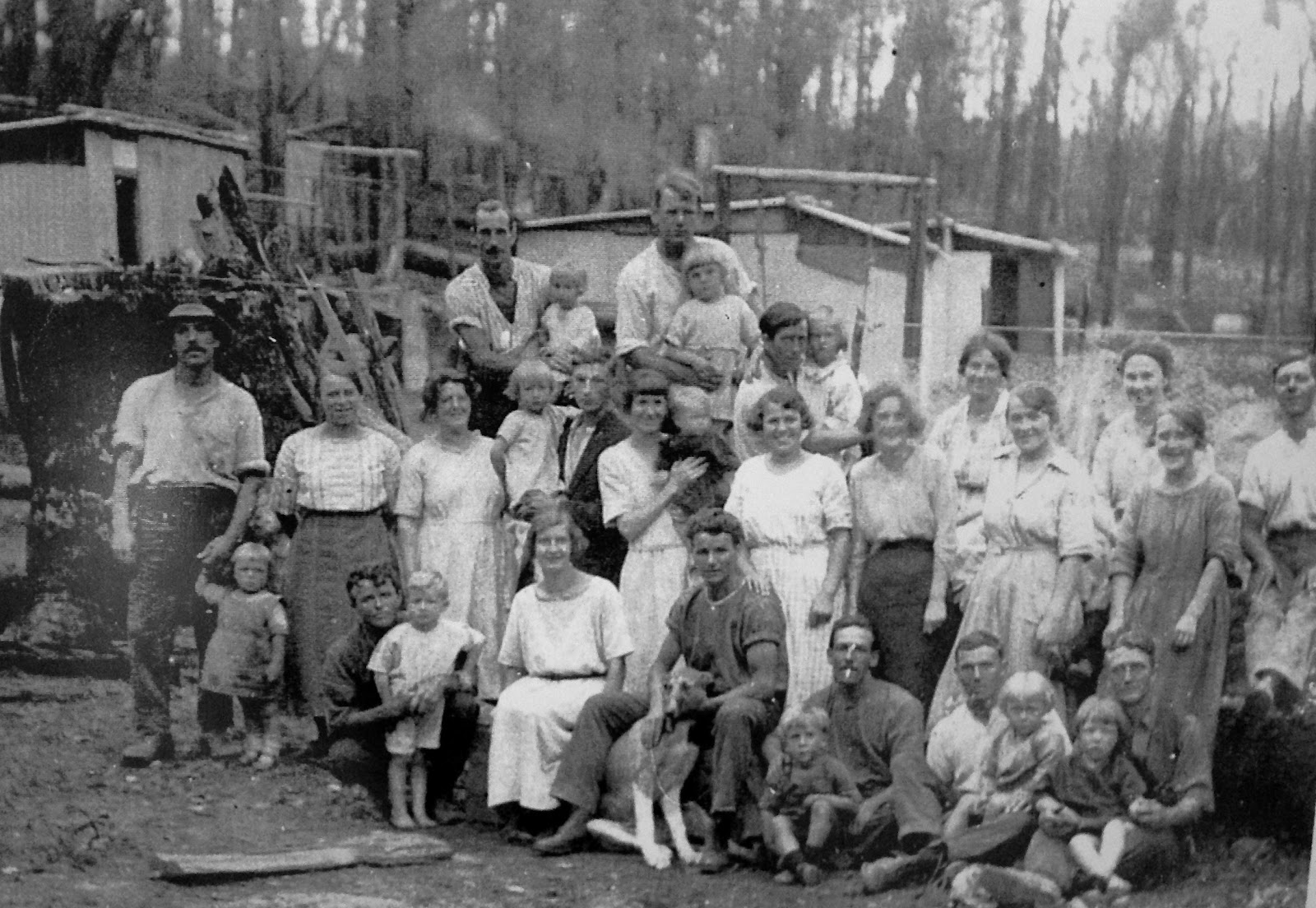

After being transported by train from Albany to Denmark the families were taken eleven miles west along the unmade Nornalup road by Reo trucks or horse-drawn carriages out into the forests where they had been assigned land on blocks that were described as containing “good swamp land, near to the sea, and embrace a commonage where fine pasture permits the immediate keeping of dairy cattle." Then, for the first time, the families understood the reality of their situation when they first caught sight of inadequate shelters of galvanised iron sheeting without windows or a floor. Eileen Croxford (née Cross), then a young girl, later recalled the moment they arrived at the camp of twenty shacks set up to receive the first of Newcombe’s groups known as Group 113: “Mum sat on her luggage, looked around and then said to Dad, ‘Do we have to live here? They wouldn’t put a cow in a byre like this at home’” For some, perhaps the dream died a little at that moment. The rest, buoyed up by the stirring words of the Premier, packed away their suits and ties, rolled up their shirt sleeves and got on with the job.

Initially, work consisted of back-breaking land clearance and by the mid-Thirties about 100,000 acres of dense forest had been cleared mostly by handsaw and fire. For those determined to make it work, and even before the stubborn-rooted Karri and Jarrah trees were felled, the hardy pioneer could already see in his mind’s eye a vision of lush pastures, fat grazing cattle and, above all, a prosperous future. 

But what started out as a 'sound scheme' soon ran into difficulties. A Royal Commission in 1926 found that land unsuitable for dairy farming had been included in the allocations and that a herd of fewer than 23 to 30 cows would not provide a farmer with a livelihood, but most settlers had fewer than ten. Unaware of the difficulties that awaited them, the 'Groupies', as they were known, made significant inroads into clearing the land, and then looked on helpless as their cattle inexplicably deteriorated into emaciated and infertile wrecks. As one settler, Fred Osborne, remembered: "After the enormous hardship of clearing the land, the care taken in establishing pastures and the excitement of stocking the new land, the animals just starved and died. In lush green pastures they simply lay down and died - bags of bones." It was not until the mid-Thirties that soil tests revealed a deficiency in the trace element cobalt. The cure was simple – with the addition of cobalt enriched Cow Lick into their feed healthy cattle once again grazed the Karri hills.  But a second blow to the farmers’ endeavours was about to fall.

When the Great Depression sweeping around the world reached Australia the country’s dependence on agricultural and industrial exports meant it became one of the hardest-hit countries in the Western world. Having conquered the land and solved the Denmark Cattle Wasting Disease the settlers were finally crushed by mounting debts as the price of butter fat plummeted and interest rates on their loans rose. After years of struggling most settlers were forced to walk off their land and abandon their efforts to a later generation. Fred Osborne’s family is one of the very few who managed to stay on, and the farm is still in their ownership today.

Group 113 member Eileen Croxford also stayed in the area. This is how she summed her time as a Groupie and what happened to her after:  

"We just lived in these shacks - no floor, no doors, no windows. I was out to work by the time I was 12. I was 20 when I got married and then I proceeded to have a family. Then the war came, my husband went away to Japan and didn't come back again". 

Newcombe's families

Newcombe and his fellow committee members have been accused of being seduced by the imagined landscapes projected by Western Australia’s publicity material while officials in Australia responded forcefully to the claim that blocks had been “window dressed” by insisting that all inspection trips were shown “as much as their time permits, and no attempt is made to conceal the sore spots”. Despite the criticisms, key values underpinning the enterprise were clear and unambiguous - hard work was at the heart of a scheme designed to appeal to anyone having difficulty in making a decent living at home, and were not afraid of getting stuck in. Newcombe never shied away from pressing this point home and never pretended that this was a land of feather beds.

Fifteen groups were eventually established in the Denmark area. They were identified by numbers. Newcombe’s groups were 113 (Parryville), 114 (Tealedale), 116 (Tingledale) and 139 (Hazeldale) – 136 families in all. They mostly arrived during 1924 and then a trickle until 1926 on the following ships of the Aberdeen Line: the Sophocles, Themistocles, Demosthenes, and the Diogenes. 
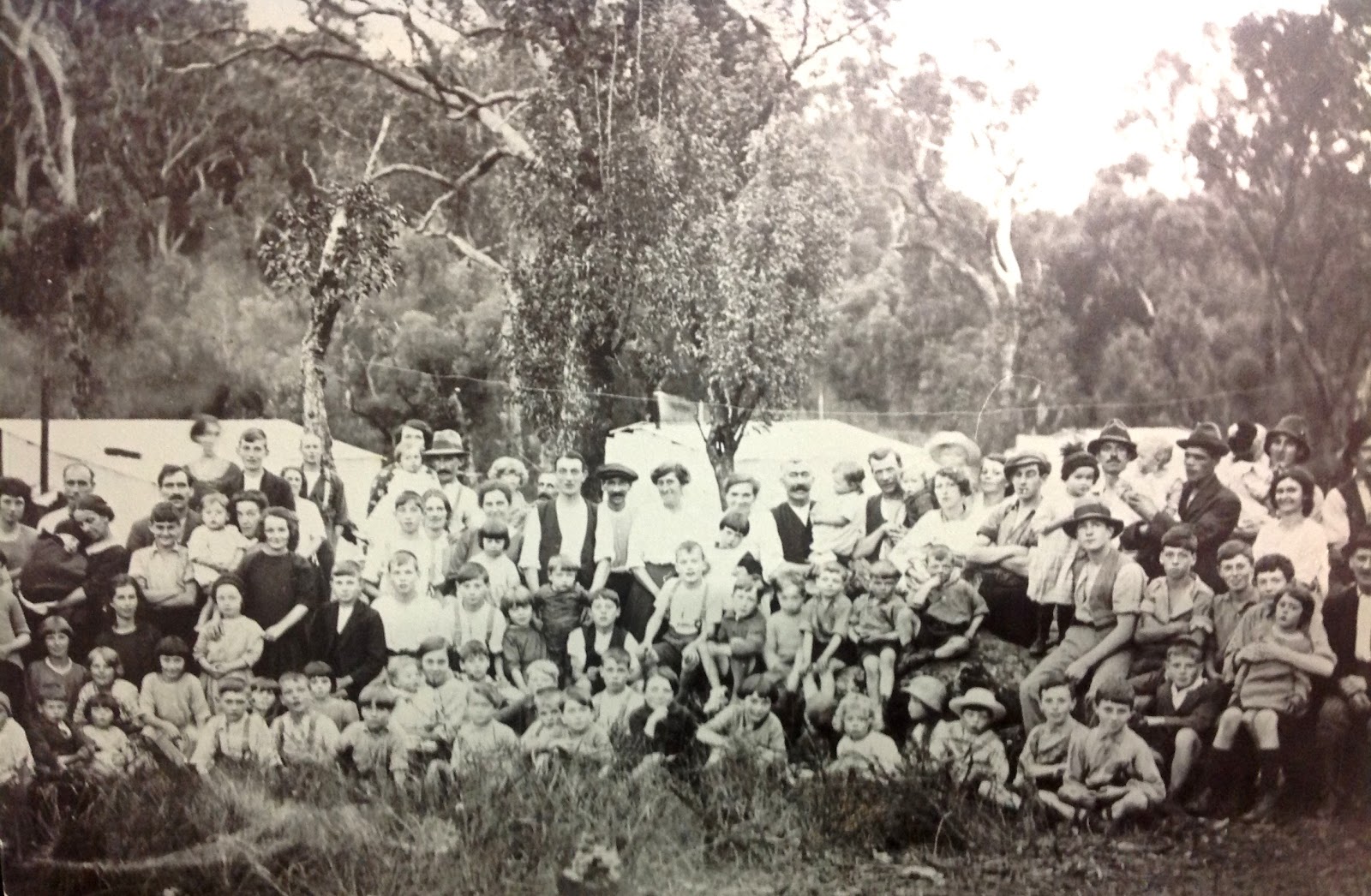
Group 116 Tingledale

The remarkable story of the Group Settlement Scheme forms a small part of the history of the development of Western Australia, but it is a story of how migration can help forge the identity of a new country. Today, the legacy of those pioneers reveals itself in unexpected ways. Although the project was declared a ‘glorious failure’ – for reasons far removed from the prodigious efforts of those involved – descendants of many of those early settlers are still in evidence across the region, and are thriving and prosperous. 

The legacy

The land that was assigned to the Groupies in Western Australia is breathtakingly beautiful, with a shoreline that contains some of the best beaches in Australia and where the might of the Southern Ocean crashes against dramatic cliffs and rock formations that seems to pre-date history itself. West of Denmark, 90-metre-high Karri and tingle trees – among the tallest in the world - are a tourist attraction in a national park that today embraces the term ‘Valley of the Giants’ as a marketing tool. In between this wonderland there exists successful farms that produce award-winning wines, succulent olives, and peppery virgin oil, complimented by honey and cheese – a not insignificant shift in economy from the 1920s and a world away from the privations experienced by the original settlers as they laid the foundation of today’s success. Self-catering accommodation located within many of the old block boundaries, now promoted as idyllic weekend retreats, completes the evolution from hardship and struggle to pleasure and relaxation.   

Backed by a strong economy and a robust tourist industry, today these are the things worth striving for on land that was once toiled with such stubborn determination and courage by a diverse group of individuals far from familiar comforts. Today, these farms form the backbone of modern Western Australia’s tourist industry, occupying the very same land that once broke the health, the spirits and the hearts of the men, women and their children who came to create new colonies on the far side of the world through sheer determination, endeavour and hope. This is their legacy.

Sunday, December 8, 2019

Endangered archaeology


After all the years I've spent researching the life of Stewart Newcombe he remains a fascinating and absorbing character, still able to surprise and still surprisingly relevant. Recently, one of his many diverse interests overlapped with a contemporary research project run by three leading British universities which has at its core the protection of endangered archaeological sites across a study area of 7000 kilometers and in more than twenty countries throughout the Middle East and North Africa. 

The EAMENA Project, a five-year Arcadia Foundation funded project (2015-2020), was set up to record and make available information about archaeological sites and landscapes which are under threat across the Middle East and North Africa. The project is based in the Universities of Oxford, Leicester and Durham. The archaeological heritage of the region, which is of international significance for all periods, is under increasing threat from massive and sustained population explosion, agricultural development, urban expansion, warfare, and looting.

The project uses aerial photography and satellite imagery to map unrecorded and endangered archaeological sites, to a uniform standard, and evaluates and monitors their condition. The information provided will assist with the effective protection of these sites by the relevant authorities. The use of satellite and aerial imagery is especially important for those countries where access on the ground is currently either impossible or severely restricted (e.g. Syria, Libya, Iraq and Yemen). 

Michael Fradley, an archaeologist at Oxford University who manages the project, contacted me seeking information on Newcombe who was an important early advocate for the use of aerial photography for photogrammetric mapping. After the end of the war Newcombe remained very vocal about the potential of the technique. In 1920 he pushed for an experimental air survey by the Royal Air Force of the Nile flood region from the old Aswan Dam to the Cairo Barrage for water management purposes but for other projects he came up against significant opposition, not least an unwillingness among the Corps of Royal Engineers to move beyond their traditional ground survey methods.

Newcombe at his Oxford house. Courtesy of Joseph Berton


Fradley, during a visit to the National Museum of Iraq in Baghdad, wrote to ask: "Just out of interest, do you know which house Newcombe lived in on the Woodstock Road in Oxford. I find myself trying to guess every time I get the bus in to work." 

Today: The site of Newcombe's former home
It is easy to see why Fradley missed it. The house at number 300 has been long gone, demolished to make way for a rather unremarkable estate of flats, which by a strange twist of irony is just a few streets away from the EAMENA Project's office. Woodstock Road is a major road running through the leafy suburb of North Oxford but the clue is obvious as Newcombe was credited when they built the current development and a prominent sign was placed at the entrance. It is doubtful if the residents of Newcombe Court are aware of the connection. 


Newcombe's air survey of the Nile in September 1920 produced 1200 glass plates of overlapping photographs but only a section of one plate was used in his 1921 paper  'Contouring by the Stereoscope on air photos' (RE Journal Vol. XXXIV July-Dec 1921). It is not known if this photographic archive exists. "If the full series of 1200 photographs survives and could be located," Fradley reflects, "it could be of major value to archaeologists to identify and document sites destroyed or eroded by the modern occupation of the Nile valley, which has increased significantly in intensity over the past 100 years." 

Contoured hills east of Cairo

Newcombe's paper won him the Royal Engineers’ prestigious Montgomerie Prize in recognition of his contribution to exploration and surveying and he continues to achieve recognition in academic journals over one hundred years later. There is a natural evolution from when a plate camera was first strapped to the wings of a wood and canvas aeroplane to the use of equipment like drones or satellites. Newcombe’s reputation was built on surveying by horse, camel or by foot across inhospitable lands often in the most appalling of conditions. At heart he was an adventurer and loved nothing better than to ride off to see what was over the next hill. But without doubt the technique of mapping the world by aeroplane and camera had begun to expose much more of its unknown and unknowable parts, more than could ever be achieved by land surveying. 

For many years Newcombe enjoyed the connectivity to the environment, and more importantly to its inhabitants, yet at the same time he recognised the need to explore ways to break free from the rigours and difficulties of those journeys and to see the world from new and exciting perspectives through the utilisation of emerging technologies that he helped develop and promote. As such he was clearly a man of his time who lived to enjoy the best of both worlds.  

For more information about the work of EAMENA, go to eamena.arch.ox.ac.uk

Thursday, June 1, 2017

Forthcoming lecture - 'Lawrence of Arabia and the Revolt in the Desert' - University of Southampton - Saturday 1 July 2017

The Lifelong Learning programme run by the University of Southampton will be holding a study day entitled: Lawrence of Arabia and the Revolt in the Desert on Saturday 1 July 2017.

I have been asked to present a paper entitled: 'A Yahoo Life' - T.E. Lawrence and the British Military Mission in the Hejaz.

The following description of the event is from the University's website where you can find details of the programme and an application form for places.

To mark the centenary of Sharif Hussein’s forces seizing the Ottoman port of Aqaba on 6 July 1917, this Great War study day focuses upon the Arab revolt against Turkish rule, and the role of archaeologist turned soldier, T.E. Lawrence. The ‘revolt in the desert’ is placed in the context of French and British intervention in the Middle East, notably the Sykes-Picot Agreement and the Balfour Declaration; the consequences of which still resonate throughout the region known then as the Levant.

Recreated in spectacular style by David Lean in the epic Lawrence of Arabia, the capture of Aqaba opened supply lines from Egypt to Allied forces operating further north in Transjordan and Greater Palestine. This effectively ended any lingering threat of a Turkish attack on the Suez Canal. By examining General Allenby’s successful offensive east of Suez in 1917-18, we can assess the military significance of Lawrence’s contribution – to what extent does the legend match reality?

Before convincing Prince Feisal and other tribal chieftains to rise up Lawrence’s involvement in the Middle East was primarily as a scholar, prompting consideration of how pre-war archaeology disguised great power interest in the crumbling Ottoman empire.

Examining Lawrence before and after the First World War offers an additional perspective on continuing conflict in the Middle East and his close connection with Southampton Water. In the 1920s and 1930s, a very public retreat from fame saw the writer of the Seven Pillars of Wisdom assume a fresh identity not once but twice, as a ranker in the Army and then the Royal Air Force. Extended service in the RAF led to a final posting in Hythe, where Lawrence worked on the British Powerboat Company’s latest rescue launches; weekends were spent at Cloud’s Hill, his Dorset cottage, or socialising in London with the likes of Churchill or Shaw. Since his death in 1935 popular interest in Lawrence and the revolt in the desert has never waned; fuelled by fresh revelations about his private life, and an urgent need to comprehend the creation myth upon which Saudi Arabia’s unbending monarchy claims its legitimacy.

This study day recognises our continuing fascination with ‘El Laurens’, and his place in the violent and crisis-ridden history of the Middle East over the past one hundred years.

Professor Adrian Smith, Emeritus Professor of Modern History, University of Southampton
- Welcome/introduction: the Solent, childhood home and workplace of T.E. Lawrence

Dr Christopher Prior, Lecturer in 20th Century History, University of Southampton
- "Immortality I cannot judge": Lawrence, the Middle East and the British Empire in the early twentieth century.

Professor Tim Champion, Emeritus Professor of Archaeology
- 'Archaeologists and great power rivalry in the Middle East prior to the First world War

Anthony Sattin, travel writer, broadcaster, and author of Young Lawrence: a Portrait of the Legend as a Young Man (2014)
- From Carchemish to Cairo: the making of Major Lawrence

Kerry Webber, writer, photographer and designer, currently writing the biography of Colonel Stewart Newcombe
- "A Yahoo Life": T.E. Lawrence and the British Military Mission to the Hejaz

Professor Adrian Smith
- The post war Lawrence: Aircraftman Shaw and the British Power Boat Company

Dr Mark Levene, Reader in History, Southampton University, and author of The Crises of Genocide Volumes I and II
- Conclusion: Thinking beyond Lawrence - the British, their role in Ottoman dissolution and the long-term consequences for the modern 'Middle East'


Sunday, February 7, 2016

Kennington's Lawrence effigy at Wareham

Lawrence effigy in repose
 
"The shock of T.E.'s death. Yes, when we were getting over it I had a letter from Buxton asking me to attend a committee which would plan a National Memorial."

The artist and sculptor Eric Kennington was among a select group of people brought together to discuss a fitting memorial following the death of T.E. Lawrence in 1935. "As far as I can remember," Kennington recalled many years later, "the other members were Buxton 'in the chair', Lady Astor, who soon elbowed him out of it and was in it herself, Newcombe, Storrs, Bernard Shaw, Lionel Curtis, Sir Herbert Baker."

Robin Buxton was Lawrence's banker and former colleague in the desert war. Lionel Curtis was an old friend and advocate of Imperial Federalism, which after its rejection in 1937 gave way to the idea of a Commonwealth of Nations. Sir Herbert Baker was an influential architect who with Edwin Lutyens had created New Delhi which became the capital of the British Raj in India. Baker had given Lawrence sanctuary in an upstairs attic room above his studios in Barton Street, Westminster, allowing Lawrence to work undisturbed on his book Seven Pillars of Wisdom.

The committee was slow to come up with suitable ideas. "Then Baker said he had asked T.E. once what his idea was for a monument to himself," Kennington recalled, "and his reply - "The largest mountain in Arabia carved into a likeness of himself!" This amused Sir Ronald Storrs who interjected, "What a fine target for the Arabs - they'd get his nose first shot." Storrs, formerly assistant to the High Commissioner in Egypt followed by spells as Governor of Jerusalem and Cyprus, was an old friend of Lawrence and was instrumental in inviting him to assess the situation in the Hejaz at the start of the Arab Revolt. He knew that no grand ideas were ever formed by committees, but a lot of foolish ideas died there. Then Baker said, "What about an effigy? We have a distinguished sculptor here." Kennington had been lying low throughout the proceedings but quickly produced some sketches which were generally accepted. Then the matter went very quiet for several months. Kennington turned to the one man he could trust to give him a straight answer. He wrote to Stewart Newcombe who replied, "Nothing doing - it's all off. They aren't going on with a National Memorial." This was a blow especially as leaflets had gone out requesting donations and had been signed by the committee members which now included Churchill, Allenby and Augustus John. The idea was quietly dropped.

Hand on Arabian khanjar dagger
Two years passed when a chance encounter at Oxford railway station between Kennington and Curtis reinvigorated the idea of an effigy. Curtis remembered their previous association and said it was a pity that the scheme for an effigy had fallen through, adding, "I wonder what it would have looked like?" "You'd better come and see it," Kennington replied. "It's almost finished."

Legs crossed at the ankles
Lawrence's brother, Arnold, came to see it and immediately offered to buy it from Kennington. "What's this worth to you?" he asked bluntly. Kennington gave a price of two thousand pounds and a cheque was drawn up there and then. But where to place it? It is not clear who first suggested the tiny parish church of St. Martin's-on-the-walls, Wareham in Dorset, but when seen today Kennington's effigy rests in the most wonderful example of a 1000 years old Anglo-Saxon church, accessible to all and in perfect harmony with its surroundings.

St. Martin's-on-the-walls, Wareham
Kennington sculpted the effigy in the style of a recumbent figure with one hand resting on the hilt of a curved Arabian khanjar dagger and one resting loosely at his side and with legs crossed at the ankles in the style of a thirteenth-century knight. Cross-legs and sword handling were features of effigies during this period, created to depict an image of repose and peace which complemented further characteristics which represented military vigour and alertness. This style persisted until the middle of the fourteenth-century when it fell out of favour to be replaced by the praying, straight-legged effigy. The meaning of the cross-legged feature was generally thought to have originated from Knights Templars or Crusaders who had died in the Holy Land, had died during the journey home, or had simply travelled east as a pilgrim or soldier. The romance of the pilgrim soldier persisted and was especially strong in the sixteenth-century, long after the period of the Crusades, reinforcing the theory. However, this crossed-legged Crusader connection has since been refuted by historians. Kennington, in reproducing the image of a 13th-century knight, was tapping into the popular beliefs held at the time.
  
Lawrence's crossed feet rest upon a piece of Hittite sculpture

Kennington was aided in his work by photos of the progress of the sculpture made by Wing Commander Reginald Simms, an amateur photographer and a former colleague of Lawrence at Bridlington during his RAF service. These undoubtedly helped Kennington during the development of the effigy, highlighting any errors. This ultimately resulted in a fine piece of work with an exquisite likeness of Lawrence in repose but also with an alertness and readiness for further action as depicted by his resting hand ready to un-sheath the curved blade. This feature was particularly pertinent when the effigy was finally placed in St. Martin's in September 1939.

Two years earlier, Churchill had contributed a piece to T.E. Lawrence By His Friends, a collection of reminiscences or impressions of Lawrence by those who knew him or had worked with him - a 'gallery of partial portraits', as Arnold Lawrence, the editor, put it. Churchill submitted a revision of an earlier obituary article published on 26 May 1935 in the News of the World newspaper, only seven days after Lawrence's death. He wrote, 'I fear whatever our need we shall never see his like again'. Churchill used much of this article at the unveiling of a memorial plaque by Kennington at the Oxford High School for Boys on 3 October 1936, an event at which Colonel and Mrs Newcombe attended and where Elsie Newcombe confessed to a bemused E.M. Forster that "Mrs Lawrence [T.E.'s mother] lovs me so much that I may kiss her here here with my rouged lips and leave spots on her face and still she doesn't mind."

Churchill included the Oxford text with further amendments in his 1937 opus Great Contemporaries where he made significant changes in both words and tone at a time when he was languishing in a political wilderness. With ominous world events pointing to another world war - in March 1936 Germany had reoccupied the Rhineland and four months later saw the outbreak of the Spanish Civil War - he used the occasion to highlight a pressing need for political effect. "All feel the poorer that he has gone from us. In these days dangers and difficulties gather upon Britain and her Empire, and we are also conscious of a lack of outstanding figures with which to overcome them."  This was not just about Lawrence. If Churchill had been side-lined at least he was able to remind his audience he was still available.

Even Lawrence's role in the RAF was utilised for Churchill's own political aims. In Friends, Churchill wrote simply that Lawrence experienced twelve years of "honourable service" in the RAF as an air-mechanic, concerned with the "mechanism of aeroplane engines, the design of flying boats." Two years later this employment was set aside in favour of a more far-reaching role that was used to bolster Churchill's own arguments for the strengthening of the aerial defence of Britain in line with the growth of the Luftwaffe.  "Those who knew him best miss him most; but our country misses him most of all. For this is a time when the great problems upon which his thought and work had so long centred, problems of aerial defence, problems of our relations with the Arab peoples, fill an even larger space in our affairs." 

With the spectre of war with Germany looming on the horizon, the tone of Churchill's revised portrait of Lawrence in Great Contemporaries became elegiac and inspirational to stir the emotions of the British public about to face their finest hour and in need of an Arthurian figure who was merely waiting for the call to arms once again. Kennington's effigy fitted the bill exactly. It would also not be long before Churchill was recalled from exile. 

NOTE
Photographs of Eric Kennington's effigy of T.E. Lawrence by Kerry Webber (December 2015), courtesy of the Rector and Churchwardens of St. Martin's-on-the-walls, Wareham.

Friday, January 29, 2016

Life on Mars - Bagnold Dunes

Further to my post Newcombe, Bagnold and the hunt for the lost oasis of Zerzura (22 March 2015) NASA reports that the Curiosity Mars rover has recently reached a field of dark dunes along the north-western flank of Mount Sharp inside Gale Crater that has been informally named "Bagnold Dunes", further proof of the importance placed by NASA on the intrepid exploits and academic research carried out by desert explorer Ralph Bagnold and his colleagues.

Bagnold's Dunes, Mount Sharp, Mars

Bagnold's seminal work, The Physics of Blown Sand and Desert Dunes (1941), was an invaluable aid to understanding dune formation and wind erosion prior to the first fully successful soft landing on Mars by a probe in 1976 from NASA's Viking programme. 

Observations of this dune field from orbit indicate that edges of individual dunes move about 3 feet (1 meter) per Earth year. This photograph (taken in December 2015) of the rippled surface of the first Martian sand dune ever studied up close was taken from Curiosity's mast camera and is an image that would have been familiar to Bagnold's own studies carried out in the Libyan Desert (Eastern Sahara).

Wednesday, January 27, 2016

14th Biennial T.E. Lawrence Symposium, St. John's College, Oxford, 23-25 September 2016

The T.E. Lawrence Society will be returning to St John’s College, Oxford, for its 14th Symposium in September 2016. Coinciding with the outbreak of the Arab Revolt in 1916, a special programme of lectures is being planned to mark this very special centenary, plus the world premiere of a new play by Jan Woolf, The Man with the Gold. Booking forms are included with this Newsletter, and will be downloadable from the Society’s website at www.telsociety.org.uk.

Friday September 23

Roger Holehouse: The Strategic Context to the Arab Revolt

Roger Holehouse OBE is a former Royal Navy officer and Foreign and Common-wealth Office civil servant. He is also a National Trust volunteer at Clouds Hill. Roger will examine the shifts in British policy towards the Ottoman Empire from the middle of the 19th century until its dissolution in 1922. He will examine the reasons behind Britain moving away from supporting the Ottomans, as a buffer against Russian expansion, in the Crimean War, to a position of fighting against them, as an ally of Russia, and supporting the Arab Revolt, in the 1914-18 war.

Dr Steve Mills, Professor Paul T. Nicholson and Hilary Rees: Views of An Antique Land: Egypt and Palestine During the First World War

Dr Steve Mills is a lecturer in archaeology at the School of History, Archaeology and Religion at Cardiff University and a specialist in auditory and sensory archaeology. He has worked in Egypt and has an established interest in landscape archaeology.

Professor Paul T. Nicholson is also at the School of History, Archaeology and Religion at Cardiff University where he teaches Egyptian archaeology and early technology. He regularly directs projects in Egypt and has an established interest in early archaeological photography.

Hilary Rees is the project officer for Views of an Antique Land. She is secretary to the Gwent branch of the Western Front Association.

This paper looks at the background to, and some of the results of, a Heritage Lottery-funded project based at Cardiff University which is examining images of Egypt and Palestine taken during the First World War. The project will provide a website which descendants of those who served in the conflict can use to better understand the landscape and societies in which their ancestors served, but will go further by providing images of the archaeological sites and settlements as well as photographs of military subjects. These, often dated, images give what is, quite literally, a snapshot of Egypt and Palestine at this important period and should prove useful to archaeologists, historians and film makers as well as to those researching military or family history.

Accompanied by a small exhibition of ephemera from the project

Saturday September 24

Philip Walker: New Light on the Arab Revolt and the Forgotten Few Who Shaped It

Philip Walker is a retired archaeologist who spent many years as an Inspector of Ancient Monuments with English Heritage. He is writing a book on his research, which grew out of a paper he presented at the Society’s 2010 Symposium. He has travelled in Libya, Palestine, Morocco, Xinjiang (the Muslim far west of China) and other parts of Central Asia. He has a particular interest in the relationship between British Intelligence and the Arab Revolt.

New research into a key group of British officers based at Jeddah demonstrates that they saved the Arab Revolt from likely collapse before and during T. E. Lawrence’s indispensable involvement. In particular, the influence of one officer over the Revolt’s leader, Sherif Hussein of Mecca, was at least as important as that of Lawrence over Emir Feisal. Without these forgotten efforts, the world would not have heard of “Lawrence of Arabia”. This paper draws on archival research including extraordinary unknown private collections of Arab Revolt photographs, letters, diaries, memoirs and other documents. Philip discovered this material by tracking down the descendants of British officers in Panama, Jamaica, the USA, Canada, Australia, Ireland, Denmark and various parts of the UK. A fresh interpretation of the Revolt will be complemented by a selection from hundreds of stunning photographs, to be shown for the first time.

Professor Ali Allawi: Feisal and the Arab Revolt

Born in Baghdad, Ali Allawi graduated in 1968 with a BSc in Civil Engineering. He continued his postgraduate studies in regional planning at the London School of Economics, and went on to obtain an MBA from Harvard University in 1971. He worked in finance and investment during the 1970s, and following an academic period at St Antony’s College, Oxford, he was appointed Minister of Trade of Iraq in 2004. In the same year he was appointed to be Iraq’s first post-war Minister of Defence. In 2005 he was elected to Iraq’s Transitional National Assembly and became Minister of Finance. Since 2006 he has been elected to different academic appointments around the world, appeared on many Western TV programmes and delivered numerous lectures related to Iraq. He has published many books on Iraq and the Islamic civilisation and in 2014 his major political biography of Feisal appeared to great acclaim. He continues to lecture and present programmes on the politics and history of the Middle East.

This paper looks at the type of states or confederation of states and political organisations that Feisal expected as an outcome of the Arab Revolt, Lawrence’s perspectives on this, and the final pattern of states that did in fact emerge. One contention is that Feisal’s vision was far more conducive to stability, security and prosperity in the post-Ottoman world than the failed mandate system.

George Thompson: Seeing Arabia: The Personal Photographs of T. E. Lawrence taken between 1916 and 1918

George Thompson lives in the United States where he devotes his time to lecturing, writing and developing programmes on the First World War. After more than 25 years in higher education, as a university professor and assistant dean, he returned to academia as an Adjunct Associate Professor in the History and Philosophy of Medicine Department at the University of Kansas Medical Centre. Professor Thompson’s knowledge of the war and his skill in programme development resulted in his being elected President of the World War Historical Association, Chair of the Midwest Chapter of the Western Front Association, US Branch, and serving as a member of the Academic Advisory Committee for the National World War One Museum and Memorial.

Seeing Arabia will examine a selection of wartime photographs taken by T. E. Lawrence. The images will be viewed from several contexts: geographical, chronological, historical, and as photographic objects. These approaches will reveal to us the man, his values and his photographic motives, and allow us to evaluate his effectiveness as a photographer. The presentation will place Lawrence in a larger context which was his era’s use of photography as a tool to document one’s perceptions and experiences.

Seeing Arabia will describe how Lawrence’s pre-war life established his aesthetic and historical views that would influence his future choice of photo-graphic content and techniques. It will also reveal why his images are not just a significant historical record but are elegant visual statements.

John Johnson-Allen: T. E. Lawrence and the Red Sea Patrol

John Johnson-Allen went to sea in 1961 with the BP Tanker Company and spent nearly nine years at sea, rising to the rank of Second Officer. He then pursued a career in the property industry. Since retiring 10 years ago, he has gained an MA in maritime history and been elected a Liveryman of the Honourable Company of Master Mariners. He is a Fellow of the Royal Historical Society and the Royal Institute of Navigation, Chairman of the Institute of Seamanship and a member of the Society for Nautical Research. He has written two previous books: Voices from the Bridge (with David Smith) and They Couldn’t Have Done It Without Us; The Merchant Navy in the Falklands War. He lectures on maritime subjects and is researching for a fourth book.

Following extensive research into the activities of the ships of the Red Sea Patrol, it has become evident that without the work of those ships, the Arab Revolt would have failed and Lawrence would have remained an obscure officer in the military bureaucracy of Cairo. This paper looks at the work of the Royal Navy, largely unreported at the time for political reasons, using primary source material from the ships’ logs and other early sources. Lawrence was aware of the importance and relevance of the Royal Navy in their Red Sea operations and commented on it on many occasions. He reported in 1918 that “the naval side of the … operations, when the time comes to tell of it, will provide a most interesting case of the value of command of the sea …” Until now, nobody has investigated what was behind those comments. This paper uncovers a new angle on the Lawrence legend.

Sunday September 25

Group Captain John Alexander: “Aeroplanes and Arabs”: T. E. Lawrence as Proponent of Air Power and the British Way in Warfare

John Alexander is a Group Captain in the RAF Regiment, the successor to the RAF armoured car companies formed to help garrison Iraq following the 1921 Cairo Conference, in which Trenchard offered Lawrence a commission. A specialist in air/land integration and an Arabic speaker, he served in the Falkland Islands in 1982; on secondment to the Sultan of Oman; at Tabuk on the Hejaz Railway in the 1990/91 Gulf War; in Iraq from 2003 to 2005; and in Afghanistan and Pakistan since 2011. He has conceptualised warfare in appointments in think-tanks at the RAF, Luftwaffe and the MOD. A graduate of Newcastle, the Open, Cambridge (as a Chief of the Air Staff Fellow) and Pakistan National Defence Universities, he was recently a Chief of the Air Staff Visiting Research Fellow at the Changing Character of War programme at Pembroke College, Oxford. He has published in the Royal United Services Institute Journal (based on his work on Taliban outreach), Air Power Review and Asian Affairs. T. E. Lawrence’s fame derived from the contrast between the warfare of the Arab Revolt and the attrition of the Western Front. His conception of guerrilla warfare influenced Basil Liddell Hart’s theory of the “Indirect Approach” and his cultural understanding is now a totem for contemporary counter-insurgents. Yet in the ever growing Lawrence literature there is little linking his concept of war-fare and his choice of Service for post-war enlistment. This paper uses archival research to argue that Lawrence and his colleagues employed a strikingly modern British “way in warfare”, using armoured cars, machine guns and aeroplanes to avoid Arab attrition and minimise British presence, and Britain’s economic and maritime strength to subsidise proxies and provide operational mobility. The paper concludes that this example of liberal militarism throws light on Lawrence’s subsequent support for air control in Iraq, and enlistment in the RAF.

Kerry Webber: Colonel Newcombe and Lawrence: Beyond Arabia

Kerry Webber is a British writer, photographer and designer who has spent many years travelling and working in the Middle East. He became interested in the Arab Revolt and the Palestine Campaigns of the First World War which inevitably brought him into contact with the legend of “Lawrence of Arabia”. Intrigued by Lawrence’s claim that fellow officers could “each tell a like tale”, he began to explore those peripheral figures and decided to research the life of Stewart Newcombe, eventually publishing articles and giving lectures on his findings. In 2000 he joined the T. E. Lawrence Society and was elected to its Committee, sitting on its editorial panel under the chairmanship of the late Philip Kerrigan. Kerry also contributes biographies to the Oxford Dictionary of National Biographies. He now lives in Spain and his book on Newcombe will be published in 2016.

Colonel Newcombe of the Royal Engineers was already a legend in the deserts of Arabia before he was joined in Cairo during the early months of the First World War by a group of extraordinary specialists in Middle Eastern affairs. One member of this group was T. E. Lawrence. Newcombe’s story, like those of other unsung figures in the Anglo-Arabian theatre of war, has been eclipsed by the legend of “Lawrence of Arabia”, and has languished in the dusty recesses of regimental records, government files or in the words of Seven Pillars of Wisdom.

Colonel Newcombe and Lawrence: Beyond Arabia explores the unique friendship between the two men, that began in a pre-war desert meeting south of Beersheba and endured for more than 20 years until Newcombe was at last able to describe Lawrence as being like a younger brother. At Lawrence’s funeral, history records Newcombe as representing the Arabian years as one of the six pall bearers; this paper shows how much more this relationship meant to both men.

Dr Neil Faulkner: Lawrence of Arabia’s War

Neil is an archaeologist and historian who works as a lecturer, writer, editor and broadcaster. He is co-director of the Sedgeford Historical and Archaeological Research Project in Norfolk and the Great Arab Revolt Project in Jordan. Educated at King’s College, Cambridge, and the Institute of Archaeology, University College London, he is a Research Fellow at the University of Bristol and Editor of Military History Monthly. The author of countless magazine articles and academic papers, his books include: Apocalypse: The Great Jewish Revolt against Rome, AD 66-73; Rome: Empire of the Eagles; and A Visitor’s Guide to the Ancient Olympics. Lawrence of Arabia’s War will be published by Yale University Press in Spring 2016.

Neil Faulkner was joint academic director of the decade-long Great Arab Revolt Project in Jordan. The discovery and interpretation of the archaeological remains have transformed understanding of the war in the desert in 1916-18. Neil will address four of the key themes: 1). The way in which Lawrence’s character as a Romantic and an Orientalist equipped him to play a unique role in the Arab Revolt. 2) The rich interaction of tradition and modernity, symbolised by the camel and the train, during the war. 3) The seminal contribution of Lawrence and the Sherifian Arabs to the development of modern guerrilla warfare. 4) The way in which the evidence on the ground has confirmed the scale of the insurgency and the essential veracity of Lawrence’s account in Seven Pillars of Wisdom.

Accompanied by an exhibition related to the Great Arab Revolt Project in Jordan

Dick Benson-Gyles: The Boy in the Mask

Dick Benson-Gyles was educated at Marlborough College and is a graduate of Trinity College Dublin. A professional editor and freelance writer, who has been writing for the Western Morning News for 25 years, he has also been an archaeologist in Iraq and TV documentary presenter. His new book, The Boy in the Mask: The Hidden World of Lawrence of Arabia, is due to be published in Spring 2016.

This presentation will explore Dick Benson-Gyles’ quest to uncover previously unexplained areas in the life of Lawrence. The talk will explore a personal mission to reveal the man behind the mask: the secret Lawrence. Lawrence’s lost Irish heritage will be explored - his father’s real family (the aristocratic, Anglo-Irish Chapmans), his abandoned half-sisters (with evocative interviews), his illegitimacy, and his mother’s obscure forebears. His concealment from his titled and wealthy Irish family affected Lawrence more deeply than thought. We will also have an insight into some of the mysteries and questions still remaining around Lawrence and his life. The presentation will be supported by a wide range of unseen family and documentary photographs, never before published.

Please note that this is a provisional programme and may be subject to change. 

Tuesday, September 29, 2015

The Lawrence Symposium, St. John's College, Oxford, 23-25 September 2016

Next year the T.E. Lawrence Society holds its 14th Society Symposium at St. John's College, Oxford. It is also the centenary anniversary for the Arab Revolt. In recognition of the role played by Stewart Newcombe in the campaign I have been invited as a guest speaker to discuss the fascinating relationship between Lawrence and Newcombe before, during and after the Revolt. 

Also speaking will be Professor Ali Alawi, from Iraq, to talk about King Feisal and the Fall of the Ottoman Empire. His recent book on Feisal is the first complete biography of the man and the monarch who was a central player in the Revolt and the development of the Middle East after the war. 

Philip Walker will share his research on the Service and Intelligence Colleagues of Lawrence with many new insights into the Arab Revolt. A past speaker at the 2012 Symposium, Philip has recently written a book on those officers who slipped below the radar of historians, and whose role in helping safeguard and shape the Arab Revolt deserves to be celebrated as its centenary year in 2016 approaches.

Another speaker, Dr. David Murphy, also a speaker from past symposia, will present Colonel Joyce and Lawrence. 

John Alexander, from the RAF, will speak on T.E. Lawrence as a Proponent of Air Power.

Dr. Neil Faulkner from the Great Arab Revolt Project (GARP) military archaeological programme, which ended last year, will share the exciting discoveries and conclusions reached from many years' work on this project. 

With a few names still to be confirmed and announced it looks set to be a very interesting couple of days, with many new insights and research discoveries about Lawrence and his wartime activities and relationships. 

Members and non-members alike can attend the Symposium. If you wish to book a place contact the Society from their website at www.telsociety.org.uk 

Sunday, May 24, 2015

30 Brechin Place


Newcombe's place of residence after retirement

Newcombe and retirement

On his retirement from the army in 1932 Stewart Newcombe and his wife, Elsie, moved to London and took up residence at 30 Brechin Place, South Kensington, an imposing four-storied terraced townhouse with additional attic rooms and basement. He soon settled into his new life away from the regiment and found time to renew his connections with old friends and colleagues at society meetings and clubs. At 53-years old he took on a civilian job, perhaps the first and only in his life, with Turner and Newall, a company specialising in asbestos products. His continuing interest in developing sustainable heat and energy for domestic housing made T&N a perfect vehicle for expanding his theories and would help in formulating some of his untried ideas on the subject of heat retention within the home.  The asbestos industry would later became mired in litigation and controversy but at the time was thought of as no more dangerous than many other industries such as coalmining or in the manufacture of steel. Lawrence took advantage of Newcombe’s connection to order some of their products to modernise his Dorset cottage, Clouds Hill,  but even he was aware of the inherent dangers of asbestos and referred to it as that ‘beastly stuff’.    

Lawrence – Final RAF duties

As Lawrence’s time in the RAF wound down he was worked hard – or more likely worked himself hard – right up until the end. For a couple of weeks he had been overseeing the assembly of a new batch of 100 h.p. power engines destined for RAF target boats at Henry Meadows Ltd, in Wolverhampton, but could be found at any number of locations that needed his presence. After residing briefly as Henry Meadows’ guest at Windermere House, he informed Newcombe that he had been forced to take up a bug infested accommodation as Wolverhampton seemed pretty full.
Windermere House

Lawrence was deeply unimpressed by Wolverhampton calling it ‘squalid’ and a ‘cess-pit’, adding that it had ‘the worse mannered local press of my experience!’ Coming from a press-hounded man like Lawrence it must have been particularly bad, so much so that he claims to have punched an editor in the mouth. He said that it had been the first time he had done so in his life; it would not be the last.

A lull in the manufacture at Meadows’ Fallings Park factory meant more meetings with the Air Council in London or back to Southampton for further fine-tuning at Scott-Paine’s power boat yard. “Since Wolverhampton,” he wrote, “I have been to London, Nottingham and Oxford; London; Plymouth; and London again.” At some point during this time, perhaps on 16 February when Lawrence’s meeting with the Secretary of the Air Ministry, Sir Christopher Bullock, was cancelled, he spent a day with the Newcombes at Brechin Place in London. A few weeks later Liddell Hart sent Newcombe an inscribed copy of his biography ‘T.E. Lawrence’ In Arabia and After and received the following letter describing the meeting:

2 March 1934
Dear Liddell Hart, It was extraordinarily kind of you to send me the book and also to insert a very flattering inscription. Naturally it has given my wife and me very great pleasure and very many thanks. T.E. was here about three weeks ago from 10 am till 6: as bright as ever.

Yours very sincerely
Stewart F. Newcombe

A rare moment of quietude

It must have been a rare treat for Lawrence to spend a whole day with Newcombe and Elsie instead of his usual nomadic existence in lodgings with snatched meals and working day and night on double shifts, ‘oiled up to the teeth,’ as he put it, ‘fed up to the teeth: and very unpopular.’ 

30 Brechin Place, now painted red

Today the Brechin Place house is painted in a cardinal red finish - too jarring for my tastes - one of only two in a typical street of London brick facades. When I last visited Kensington the house still seemed to reverberate with conversations both serious and jocular that took place within its walls eighty years ago between two old desert warriors and a brave woman that helped one of them escape under the very noses of his Turkish captors!

I would like to thank John Meadows for placing the history of his grandfather's factory online at Henry Meadows Ltd.